AI Citation Report 2026: 15,800 AI Citations Reveal How AI Search Chooses Websites
This report analyzes **15,800+ AI citations** recorded over a 90-day period through Microsoft Bing Webmaster Tools AI Performance. Using real citation data, we examine how AI search engines evaluate websites, which software reviews receive the most AI citations, what types of content earn the highest citation share, and how AEO (Answer Engine Optimization) and GEO (Generative Engine Optimization) influence AI visibility. The report includes AI citation statistics, top-cited tools, citation share rankings, search intent analysis, and practical insights for publishers, SaaS companies, and marketers looking to increase visibility across AI search platforms such as ChatGPT, Microsoft Copilot, Gemini, Claude, and Perplexity.
Related Resources
- AI Citation Index
https://aitoolscoop.com/ai-citation-index/ - AI Tool Reviews
https://aitoolscoop.com/tool/ - AI Agents Directory
https://aitoolscoop.com/ai-agents/ - AI Comparisons
https://aitoolscoop.com/vs/ - AI Prompt Library
https://aitoolscoop.com/ai-prompts/
Abstract
Artificial Intelligence is rapidly changing how software is discovered.
Instead of browsing Google results, millions of users now ask ChatGPT, Microsoft Copilot, Gemini, Claude and Perplexity which software they should use.
Unlike traditional search engines, AI systems retrieve, compare and cite trusted sources before generating answers.
This new discovery model has created entirely new concepts including AI Search, AI Visibility, AEO (AI Engine Optimization) and GEO (Generative Engine Optimization).
To better understand how AI assistants select websites, we analyzed over 15,800 AI citations collected from Microsoft Bing Webmaster Tools AI Performance during a 90-day period.
This report examines citation volume, citation share, grounding queries, search intent, page authority and the types of software content most frequently recommended by AI systems.
Rather than presenting theories, every statistic in this report comes from real AI citation data.
Executive Summary
During the last 90 days our dataset recorded:
- 15,800+ AI Citations
- 3,600+ citations in the last seven days
- 550 citations in a single day
- 67 cited pages in one day
- Research Intent represented over 80% of all citations
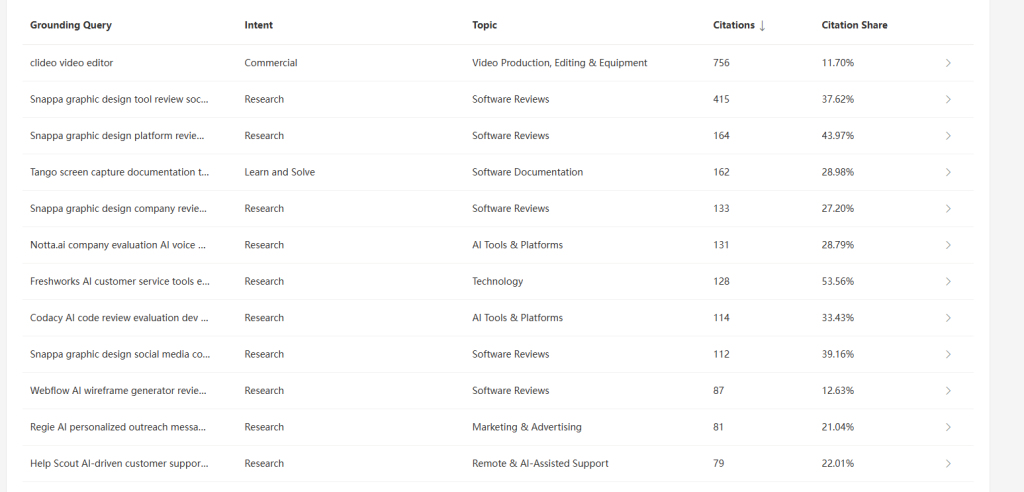
- Thousands of unique grounding queries
The data suggests that AI assistants strongly favor detailed software reviews, structured product information and topical authority rather than traditional keyword optimization alone.
AI Citation Statistics
| Metric | Value |
|---|---|
| Total AI Citations | 15,800+ |
| Last 7 Days | 3,600+ |
| Peak Daily Citations | 550 |
| Average Daily Citations | 175+ |
| Peak Cited Pages | 67 |
| Average Cited Pages | 57/day |
| Highest Citation Share | 73.91% |
| Research Intent | 80%+ |
| Primary Content Type | Software Reviews |
These statistics represent one of the few publicly available datasets showing how AI assistants reference external websites during real user conversations.
What Is an AI Citation?
An AI citation occurs when an AI assistant references a webpage while generating an answer.
For example, users may ask:
- Best AI coding tools
- Best AI customer support software
- Is Claude Code free?
- Best AI image generator
- AI sales automation tools
Instead of simply ranking webpages, AI assistants retrieve trusted sources and cite them inside their generated responses.
Being cited means your content has been selected as evidence rather than simply appearing in search results.
This represents an entirely different visibility channel compared with traditional SEO.
Why AI Citation Matters
Traditional SEO measures rankings and clicks.
AI Search measures trust.
Google asks:
Which page should rank first?
AI assistants ask:
Which page should I trust enough to quote?
That distinction changes how software publishers should think about content.
The goal is no longer only to rank higher.
The goal is to become the source AI chooses to reference.
AI Citation Index
The complete AI Citation leaderboard is updated continuously:
https://aitoolscoop.com/ai-citation-index/
The index tracks software reviews, AI agents, prompt libraries, comparison pages and other content that receives citations from Microsoft Copilot and partner AI systems.
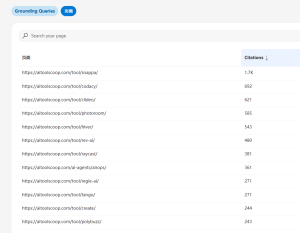
Top 20 Most Cited Pages
These pages generated the largest number of AI citations during the reporting period and collectively represent multiple software categories including design, productivity, coding, customer support, documentation, AI agents and enterprise SaaS.
Citation Distribution by Content Type
Our dataset also reveals which types of pages AI assistants prefer to cite.
| Content Type | Estimated Share |
| Tool Reviews | 85% |
| AI Agents | 6% |
| Comparison Pages | 4% |
| Prompt Libraries | 3% |
| Other Editorial Content | 2% |
Comprehensive review pages remain the strongest source of AI citations.
However, comparison pages, AI prompt libraries and AI agent directories are increasingly appearing in AI-generated responses as users ask more complex research questions.
Internal Resources
Readers interested in exploring the highest-performing pages can browse the following collections.
AI Citation Index
https://aitoolscoop.com/ai-citation-index/
AI Tool Reviews
AI Agents
https://aitoolscoop.com/ai-agents/
AI Prompt Library
https://aitoolscoop.com/ai-prompts/
AI Comparisons
These resources are updated regularly as new software reviews and AI citation data become available.