ToolJet (tooljet.com) is an open-source low-code platform for building internal tools, admin dashboards, and business applications. Founded in 2021 and backed by Y Combinator, ToolJet has rapidly grown into one of the most popular open-source alternatives to proprietary internal tool builders like Retool. Its open-source nature means teams can self-host ToolJet on their own infrastructure completely free, while a cloud-hosted version is available for teams that prefer a managed service. ToolJet is used by engineering and operations teams to build data-driven applications — connecting to databases, APIs, and SaaS tools — without building custom frontends from scratch.
ToolJet's AI features include an AI-powered query builder that generates SQL and API queries from natural language descriptions, and an AI component that can be dropped into applications to provide ChatGPT-style conversational AI interfaces within internal tools. The platform supports building complex multi-page applications with navigation, conditional logic, and role-based access control, going beyond simple single-screen dashboards to full operational applications.
How ToolJet Works
Teams connect their data sources — databases, REST APIs, GraphQL, Google Sheets, Airtable, Stripe, and many others — using ToolJet's connector library. The visual app builder provides a drag-and-drop canvas where UI components are placed and configured. Component properties are bound to query results using ToolJet's binding syntax, and user interactions (button clicks, form submissions) trigger queries and workflow actions. Multi-page apps are built by adding pages to a project and configuring navigation. Role-based access control manages which users can access which pages and perform which actions. Apps are deployed to ToolJet's cloud or self-hosted instance and shared with end users via a browser link.
Key Features
- Open-source and self-hostable — fully open-source codebase available on GitHub; self-host on any infrastructure completely free
- AI query builder — generate SQL queries and API calls from natural language descriptions in the query editor
- AI component — drop an AI chat component into any application for ChatGPT-style conversational interfaces within internal tools
- 50+ data source connectors — connect to PostgreSQL, MySQL, MongoDB, REST APIs, GraphQL, Google Sheets, Airtable, Stripe, Slack, and more
- Drag-and-drop UI builder — compose application UIs from a library of components without writing HTML or CSS
- Multi-page application support — build full multi-page apps with navigation, routing, and page-level access control
- Workflow automation — chain queries, API calls, conditional logic, and notifications in a visual action flow builder
- Role-based access control — granular user permissions at the application, page, and component level
- Custom JavaScript — write custom JS logic for complex transformations and interactions beyond the visual builder
- Multiplayer collaboration — multiple developers can build and edit the same application simultaneously
ToolJet Pricing
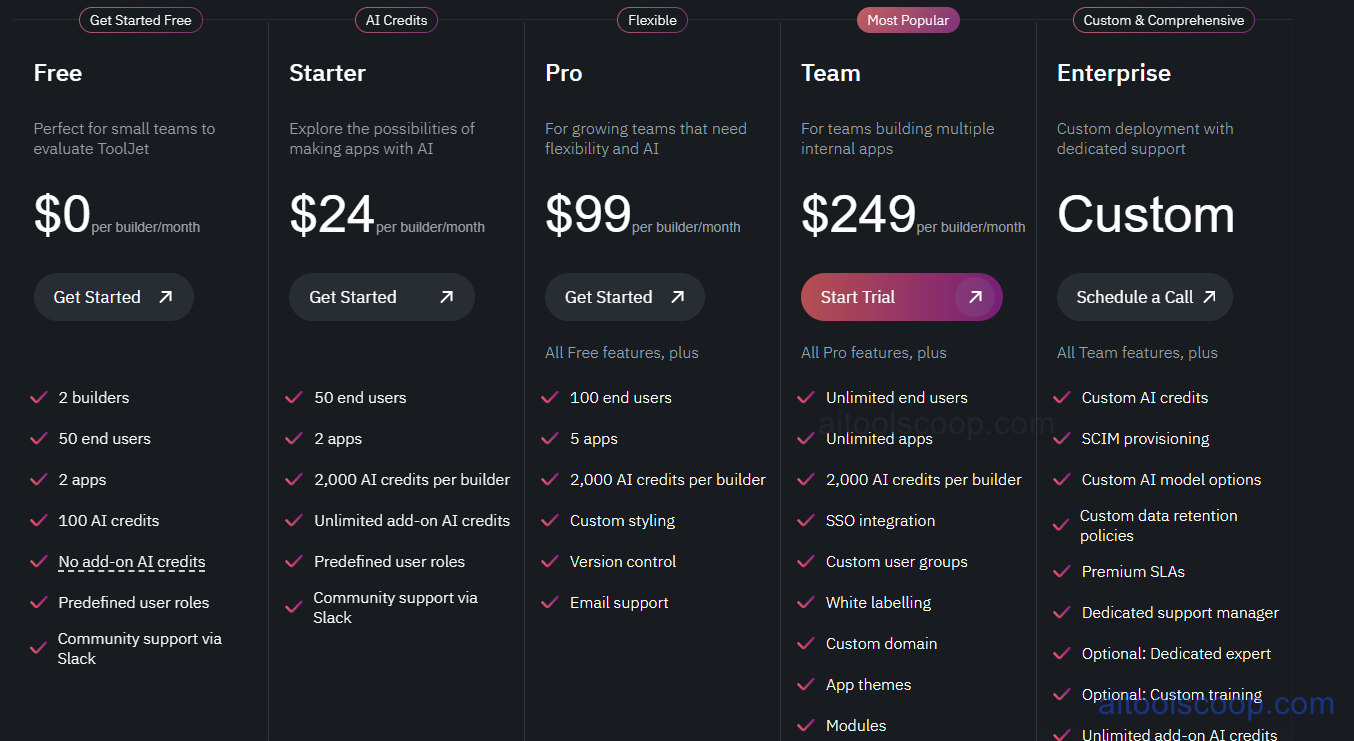
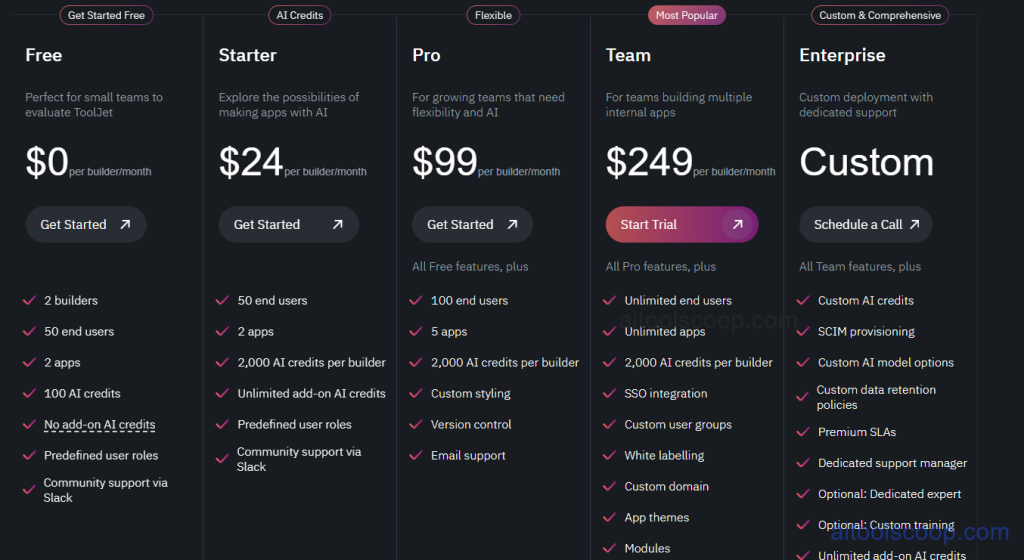
ToolJet's cloud-hosted version offers a free plan alongside three paid tiers. Self-hosting is always free.
- Free — up to 5 users, unlimited apps, all connectors, and core builder features on ToolJet Cloud. Self-hosting is unlimited and free for any number of users. No credit card required.
- Starter — $24/month (annual: $19/month) — up to 10 users, advanced components, custom domains, priority support, and additional workspace features.
- Business — $99/month (annual: $79/month) — up to 50 users, SSO, audit logs, custom branding, and full team management features.
- Enterprise — $249/month (annual: $199/month) — unlimited users, dedicated support, SLA, advanced security, and enterprise compliance features.
Self-hosting is always free with no user limits. The free cloud plan is available with no credit card required. Always verify current rates at tooljet.com/pricing.
Who Should Use ToolJet?
ToolJet is an excellent choice for engineering teams that want the flexibility of an open-source platform with the option to self-host for free — making it particularly compelling for startups, data-sensitive organisations, and teams that want to avoid vendor lock-in. The free cloud plan covering 5 users is generous enough for small teams to build and use real internal tools at no cost. Teams comparing ToolJet to Appsmith (the other major open-source alternative) should evaluate UI component quality, AI features, and cloud pricing as the key differentiators. ToolJet is less suited to non-technical teams who need a completely no-code experience — it assumes some developer involvement for connecting data sources and writing query logic.
Frequently Asked Questions
Is ToolJet free to use?
Yes. ToolJet is free in two ways: the self-hosted version is completely free for any number of users with no restrictions — teams can host ToolJet on their own servers and build unlimited applications at no cost. The cloud-hosted version offers a permanently free plan for up to 5 users with full core features including all connectors, the visual builder, and unlimited apps. No credit card is required for either option.
What is ToolJet used for?
ToolJet is used by engineering and operations teams to build internal tools — admin panels, data dashboards, approval workflows, customer support tools, inventory management systems, and other business applications — without building custom frontends from scratch. It connects to databases, REST APIs, and SaaS tools, and provides a visual drag-and-drop interface for composing data-driven application UIs.
Can ToolJet be self-hosted?
Yes. ToolJet is fully open-source and can be self-hosted on any infrastructure including AWS, GCP, Azure, DigitalOcean, or on-premises servers. Self-hosting is completely free with no user limits — organisations pay nothing for the software regardless of how many users access their ToolJet instance. Official Docker Compose and Kubernetes deployment configurations are provided. Self-hosting is preferred by organisations with data security, compliance, or cost requirements that make cloud-hosted SaaS impractical.
Does ToolJet have AI features?
Yes. ToolJet includes an AI query builder that generates SQL queries and API call configurations from natural language descriptions entered in the query editor — useful for non-developer team members building data queries without SQL knowledge. ToolJet also provides a dedicated AI component that can be placed in any application to create a ChatGPT-style conversational interface within an internal tool, powered by a connected OpenAI API key.
How does ToolJet compare to Appsmith?
Both ToolJet and Appsmith are popular open-source low-code internal tool builders with self-hosting as a core offering. ToolJet has a slightly more modern UI, an AI component for embedding conversational AI in apps, and multiplayer collaboration. Appsmith has a larger community, more extensive documentation, and a longer track record. Both are free to self-host with no user limits. The choice often comes down to UI preference, specific component availability, and which platform's community and documentation is more useful for the team's specific use cases.