
Best AI Research Assistant for Literature Reviews
Elicit (elicit.com) is an AI research assistant developed by Ought, a nonprofit machine learning research lab. Used by over 2 million researchers worldwide, Elicit searches across 138 million academic papers and 545,000 clinical trials using semantic search — meaning it understands the intent behind your research question, not just keywords. It extracts structured data from papers into customizable tables, automates systematic reviews to PRISMA 2020 standards, and generates citation-backed research reports. Researchers report up to 80% time savings on systematic literature reviews using Elicit.
How Elicit Works
Type a research question into Elicit in plain language — no need for Boolean operators or precise keywords. Elicit's semantic search engine scans 138 million papers from Semantic Scholar and other sources to find the most relevant studies. Results appear in a customizable table where you can add columns for any data point you need: sample size, methodology, outcomes, effect sizes, or custom extraction criteria. For systematic reviews, Elicit automates the screening and data extraction stages, applying your inclusion and exclusion criteria at scale. The Research Agent on Pro and Scale plans can also search beyond academic papers to include clinical trial registries, regulatory documents, and press releases. Every AI-generated claim includes a sentence-level citation linking directly to the source paper, eliminating hallucinations and maintaining research integrity.
Key Features
- Semantic paper search — Search 138M+ academic papers and 545K clinical trials by research question, not just keywords
- Automated data extraction tables — Define custom columns and Elicit populates structured data from dozens of papers instantly
- AI Research Reports — Generate 10+ page literature reviews with sentence-level citations in seconds
- Systematic Review Workflow — PRISMA 2020-compliant screening and extraction with 97% abstract screening accuracy
- Research Agent — Searches beyond academic databases to include clinical trials, regulatory docs, and press releases (Pro+)
- Sentence-level citations — Every AI claim links to the exact sentence in the source paper, preventing hallucinations
- Concept suggestions — Elicit identifies related research concepts to expand your literature search
- Zotero integration — Export papers and citations directly to Zotero and other reference managers
- Collaborative tables — Real-time editing and team collaboration on extraction tables (Scale plan)
- API access — Programmatic access to Elicit's search and report generation for custom research workflows
Elicit Pricing
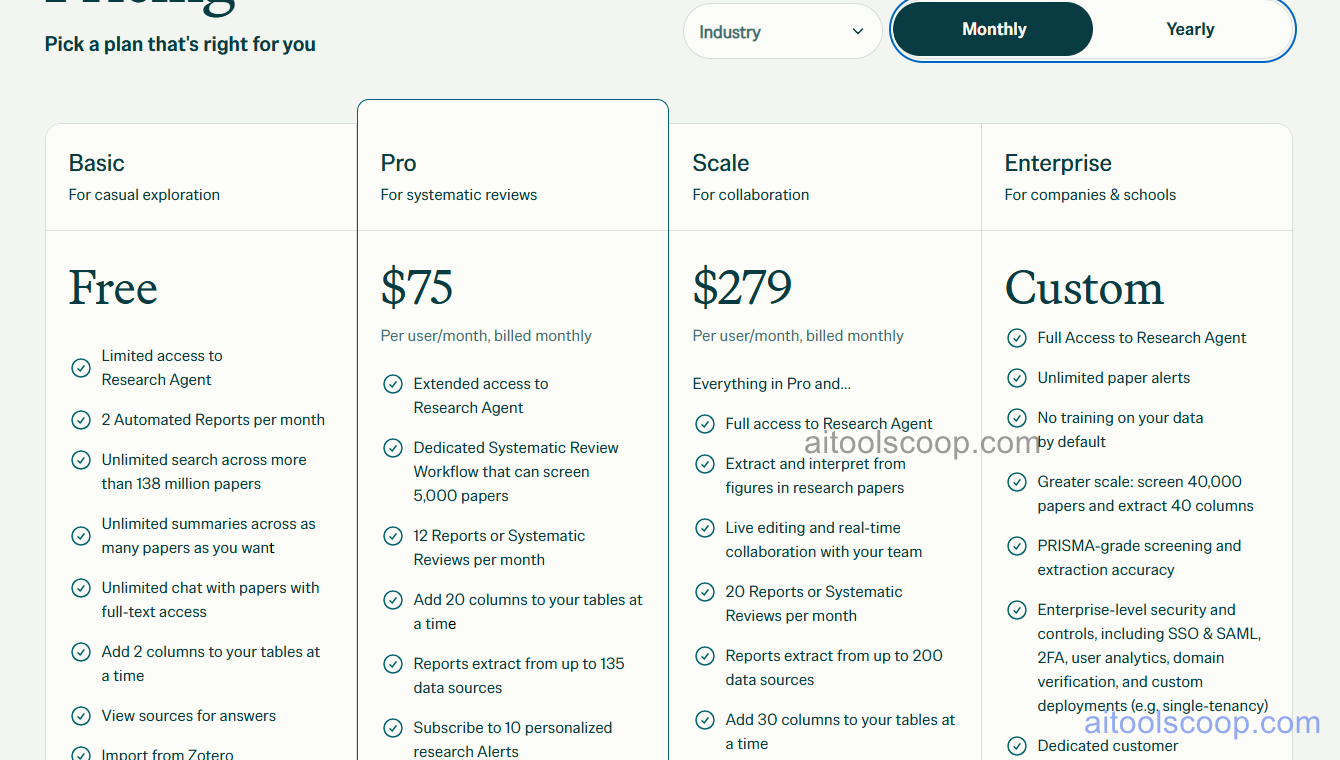
| Plan | Monthly | Annually | Key Features |
|---|---|---|---|
| Basic | Free | Free | 2 reports/month, unlimited search, 2 table columns, Zotero import, chat with papers |
| Pro | $75/mo | $49/mo ($588/yr) | 12 reports/month (144/yr annual), Research Agent, systematic review workflow (5,000 papers), 20 columns, 135 data sources, 10 research alerts |
| Scale | $279/mo | $169/mo ($2,028/yr) | 20 reports/month (240/yr annual), full Research Agent, figure extraction, live collaboration, 200 data sources, 30 columns, admin panel |
| Enterprise | Custom | Custom | 40,000 paper screening, 40 columns, PRISMA-grade accuracy, SSO/SAML/2FA, no training on your data, dedicated success team |
Always check the latest rates on the official website. For more AI tool reviews, visit aitoolscoop.com.
Who Should Use Elicit?
Elicit is built for academic researchers and graduate students conducting systematic or narrative literature reviews who need to screen and extract data from large numbers of papers efficiently. Medical researchers and clinical scientists use it to accelerate evidence synthesis for systematic reviews, meta-analyses, and drug development research. Corporate research teams at pharmaceutical companies, consulting firms, and policy organizations use Scale and Enterprise plans for large-scale evidence reviews. The free Basic plan works well for students writing dissertations or anyone who needs to conduct occasional literature searches. Elicit is not the right tool if you need a writing assistant or citation manager — it finds and extracts, but does not write manuscripts.
Frequently Asked Questions
Yes, Elicit has a permanently free Basic plan. It includes 2 automated research reports per month, unlimited search across 138 million papers, 2 table columns for data extraction, unlimited paper summaries, and Zotero import. The free plan is sufficient for students and occasional researchers. Pro ($75/month or $49/month billed annually) and Scale ($279/month or $169/month annually) unlock more reports, more columns, the Research Agent, and systematic review workflows.
Elicit Basic is free. Pro costs $75/month (billed monthly) or $49/month billed annually as $588/year — a 35% saving. Scale costs $279/month or $169/month billed annually as $2,028/year — a 39% saving. Enterprise pricing is custom. Annual Pro and Scale plans deliver the full year's report quota upfront rather than monthly.
Elicit is developed by Ought, a nonprofit ML research lab focused on research integrity. Every AI-generated claim includes a sentence-level citation linking to the exact source sentence in the underlying paper, which prevents hallucinations. Independent benchmarking shows Elicit achieves 95% search recall, 97% abstract screening accuracy, and 99% full-text screening accuracy across Cochrane reviews. That said, all outputs should be verified against original source papers before use in published research — no AI tool replaces expert judgment.
Elicit is best for systematic literature reviews, evidence synthesis, and structured data extraction from large sets of academic papers. Its strongest use case is defining custom columns — sample size, methodology, outcomes, effect sizes — and having Elicit populate those columns across 50 to 200 papers automatically. Medical researchers use it to screen clinical trials; pharmaceutical teams use it for drug literature reviews; academics use it to accelerate the screening stage of systematic reviews by weeks.
No, Elicit is a web-based tool accessible at elicit.com. There is no dedicated iOS or Android app. The platform works in any modern desktop browser and is optimized for research workflows that involve reviewing tables and managing large paper sets — tasks better suited to desktop than mobile.
The top Elicit alternatives include Consensus (better for quick evidence-based answers to specific questions), SciSpace (stronger for reading and annotating individual papers), Semantic Scholar (free paper discovery with citation graphs), and Scite (unique citation context analysis showing whether papers support or contradict each other). PapersFlow adds manuscript writing to the research workflow that Elicit does not provide. Choose Elicit if systematic data extraction at scale is the priority.