

Hume AI (hume.ai) is an AI research company and developer platform founded in 2021 by Dr. Alan Cowen, a former researcher at Google Brain specialising in the science of emotion. Hume's mission is to develop AI systems that can understand and respond to human emotional expression — through voice tone, facial expressions, and physiological signals — rather than relying solely on the literal content of words. The company's platform provides APIs for emotion measurement and an empathic voice interface (EVI) that generates spoken AI responses which adapt in tone and expression based on the emotional state detected in the user's voice.
Hume AI's Empathic Voice Interface (EVI) is a full-duplex conversational AI voice API that can listen, understand emotional context, and respond with a synthesised voice whose tone, pacing, and expressiveness adapt to the user's detected emotional state in real time. Unlike standard TTS or voice assistants, EVI is designed to make AI voice interactions feel more natural, empathetic, and human — making it relevant for mental health apps, customer service, companionship AI, and accessibility tools. The emotion measurement APIs separately cover facial action unit detection, vocal burst recognition, and prosody analysis for developers building emotion-aware applications.
How Hume AI Works
Developers integrate Hume's APIs into their applications using the Python or TypeScript SDK or direct REST calls. The EVI API establishes a WebSocket connection for real-time voice conversation — the application streams user audio to Hume, which processes speech, detects emotional signals, generates a contextually appropriate response using an underlying LLM, and returns synthesised speech with emotionally adapted prosody. The emotion measurement APIs accept audio clips, video frames, or physiological data and return emotion scores across a taxonomy of 53+ emotion dimensions. Hume's playground at the company website allows direct interaction with EVI without coding to experience the capabilities before building.
Key Features
- Empathic Voice Interface (EVI) — full-duplex conversational AI voice API that adapts speech tone and expressiveness to detected user emotional state in real time
- Emotion measurement APIs — measure 53+ emotion dimensions from audio, video, and physiological signals for emotion-aware application development
- Vocal burst recognition — detects non-verbal vocal expressions (laughter, sighs, gasps) alongside spoken content for richer emotional understanding
- Facial expression analysis — measures facial action units and emotional expressions from video input in real time
- Prosody analysis — analyses speech rhythm, intonation, and pace to infer emotional state from voice alone
- LLM integration — EVI combines emotion understanding with an underlying language model for contextually and emotionally coherent responses
- Python and TypeScript SDKs — official developer SDKs for integrating Hume APIs into applications quickly
- WebSocket streaming — real-time bidirectional audio streaming for low-latency conversational voice applications
- Custom system prompts — configure EVI's personality, focus area, and response style for specific application contexts
- Playground — interactive no-code interface to experience EVI conversations directly before building
Hume AI Pricing
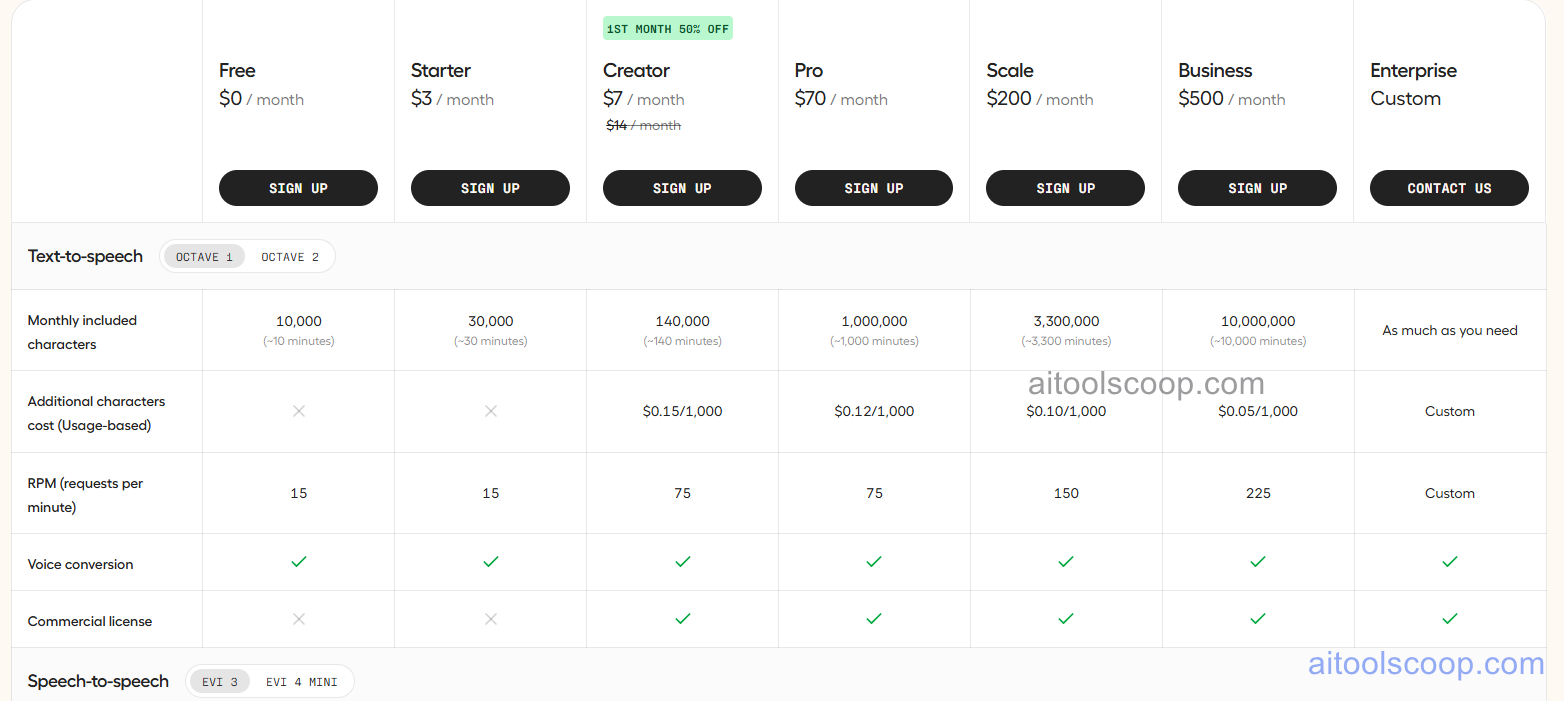
Hume AI offers usage-based pricing tiers starting from a free tier for developers.
- Free — $0/month — limited API calls per month for EVI and emotion measurement APIs, access to all endpoints, and playground access. No credit card required. Suitable for prototyping and early development.
- $3/month — entry-level paid tier with increased API call allowance for small-scale development and testing.
- $7/month — expanded API usage for individual developers building personal or small projects.
- $70/month — higher-volume API access for small-scale production applications.
- $200/month — production-grade API access for growing applications with significant voice and emotion measurement usage.
- $500/month — high-volume tier for larger applications and teams with substantial API call volumes. Custom enterprise plans available above this level.
The free tier is permanently available with no credit card required. Always verify current rates at hume.ai/pricing.
Who Should Use Hume AI?
Hume AI is designed for developers and AI product teams building applications that need to understand and respond to human emotional expression — mental health and wellness apps, companionship AI, empathic customer service agents, accessibility tools, and emotion-aware educational platforms. Its EVI API is the most advanced commercially available conversational voice interface that adapts emotionally in real time, making it a significant differentiator for applications where conversational naturalness and emotional appropriateness matter. Hume is not a no-code or end-user tool — it is a developer API platform requiring technical integration. Non-developers looking for a voiceover or TTS tool should look at Murf AI or ElevenLabs instead.
Frequently Asked Questions
What is Hume AI used for?
Hume AI is a developer API platform used to build applications that can measure human emotional expression and generate emotionally adaptive AI voice responses. Its Empathic Voice Interface (EVI) is used in mental health apps, companionship AI, customer service agents, and accessibility tools. The emotion measurement APIs are used by researchers and developers building systems that need to understand facial expressions, vocal tone, and prosody in real time.
Is Hume AI free to use?
Yes. Hume AI offers a permanently free tier that provides limited monthly API calls for both the EVI conversational voice API and the emotion measurement APIs. No credit card is required. The free tier is intended for developers prototyping and evaluating the capabilities before scaling to a paid tier. Paid tiers start from $3/month for increased API call allowances.
What is the Empathic Voice Interface (EVI)?
The Empathic Voice Interface (EVI) is Hume AI's conversational voice API that combines speech recognition, real-time emotion detection, a language model for generating contextually relevant responses, and an emotionally adaptive text-to-speech engine. Unlike standard voice assistants, EVI detects emotional signals in the user's voice — tone, pacing, vocal bursts — and generates spoken responses whose prosody, pace, and expressiveness adapt to match the detected emotional context, making conversations feel more natural and empathetically attuned.
What emotions can Hume AI detect?
Hume AI's emotion measurement models can detect more than 53 distinct emotion dimensions from audio, video, and physiological signals — going far beyond the basic six emotions (happy, sad, angry, fearful, disgusted, surprised) that most emotion detection systems cover. The taxonomy is grounded in Dr. Alan Cowen's academic research on the science of emotion and covers nuanced states such as amusement, awe, confusion, contemplation, craving, embarrassment, and many others that are relevant to human experience but rarely captured by simpler models.
Does Hume AI require coding to use?
Hume AI is primarily a developer API platform and requires coding knowledge to integrate into applications. Official Python and TypeScript SDKs are provided to simplify integration, and API documentation covers REST and WebSocket endpoints. The Hume playground at the website allows anyone to experience EVI conversations without coding, but building applications with Hume's capabilities requires development work. Non-developers looking for a voice or emotion tool without coding should evaluate other platforms.