

Topicfinder (topicfinder.com) approaches content ideation from the competitor side rather than the keyword-tool side. Instead of starting from a seed keyword and a search-volume estimate, it starts from a primary website and a competitor site, then scans thousands of similar domains to surface pages that are already earning traffic in that niche. The tool was built by a content marketing agency that produces its own longform articles at volume, and that origin shows in how the product is scoped: less keyword-database browsing, more direct competitor-page mining.
The core audience is content marketers, SEO teams, and agencies who need a steady pipeline of topics that have a proven traffic track record rather than a theoretical one. Because Topicfinder runs its scans across many domains simultaneously, it's positioned for people managing content research at scale — several writers, multiple client sites, or a single blog competing directly against a handful of larger publishers.
How Topicfinder Works
A project starts with two inputs: a primary site (usually the user's own) and one known competitor. From there, Topicfinder's crawler identifies a wider set of domains that share similar content and keyword overlap, then pulls each domain's best-performing pages along with traffic and SEO metrics for every one. Because the scan runs multi-threaded across many domains at once, a single report can return hundreds or thousands of candidate topics rather than the handful a manual search would turn up. From that raw list, real-time filters narrow the set down by traffic share, competition level, and domain authority, and the Content Planner then turns a chosen topic into an AI-generated title variation and a sample outline, so the topic can go straight into a writer's hands.
Key Features
- Competitor-based topic discovery: starts from a primary site plus one competitor and expands out to thousands of related domains rather than requiring keyword lists
- Multi-threaded scanning: pulls hundreds of URLs per second across parallel tasks, returning large topic samples per report far faster than sequential manual research
- Real-time SEO filters: narrows large result sets live by traffic share, domain authority, and competition level to isolate the topics worth pursuing
- Content Planner: generates AI title variations for a chosen topic, scored against Google's length requirements, alongside a sample article outline
- Favorites and tagging: stores chosen topics directly in the dashboard for later retrieval, so one research project can supply a production pipeline for months
- Bulk export: exports SEO insights and topic lists across hundreds of competitor pages at once instead of merging data manually from separate tools
- Team collaboration: shared dashboards and report sharing let a team coordinate content research and planning from the same project data
Topicfinder Pricing
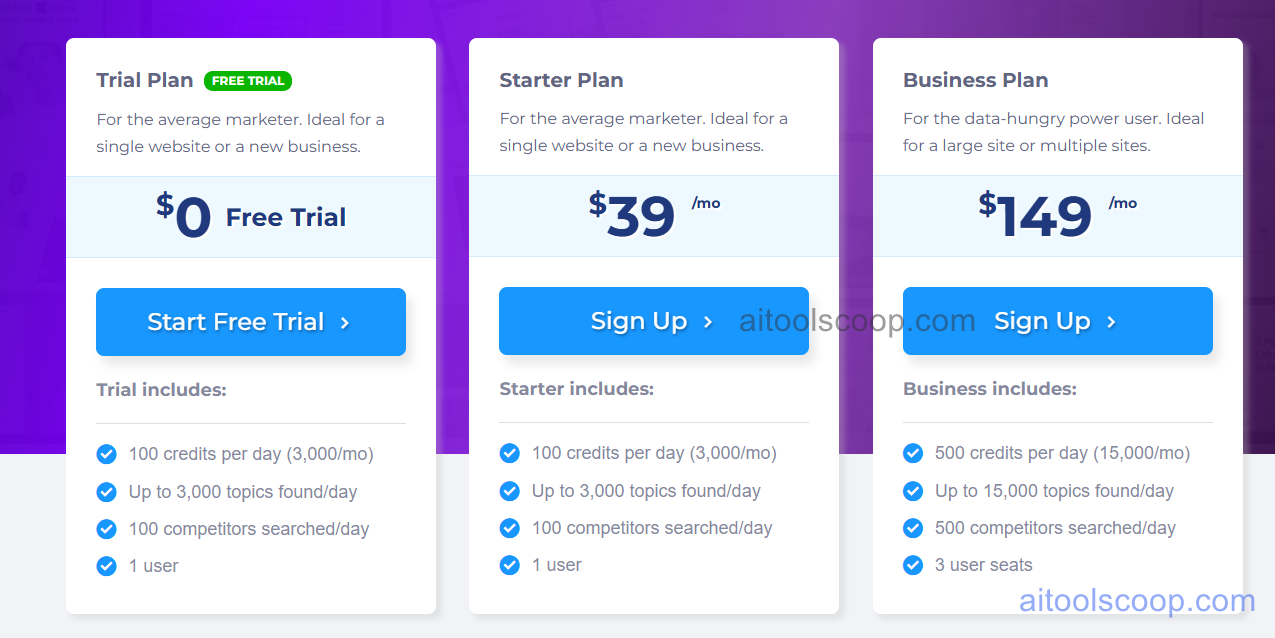
- Trial Plan — Free — 100 credits per day (3,000/month), up to 3,000 topics found per day, 100 competitors searched per day, and 1 user seat, for testing the platform before paying.
- Starter — $39/month — the same daily limits as the trial (100 credits/day, 3,000 topics/day, 100 competitors/day, 1 user seat), intended for ongoing single-user use once the trial period ends.
- Business — $149/month — 500 credits per day (15,000/month), up to 15,000 topics found per day, 500 competitors searched per day, and 3 user seats, aimed at teams researching across multiple sites or clients.
Topicfinder is billed monthly; no annual discount plan is listed on the pricing page. Pricing verified against topicfinder.com; rates may change — always confirm current pricing at topicfinder.com.
Who Should Use Topicfinder?
A solo blogger or freelance content marketer researching topics for one site fits comfortably on Starter, where the daily credit and competitor limits match what the free trial already offers. Agencies and in-house teams managing several client sites, or anyone who needs more than one person working inside the same research project, will find the Business plan's higher daily caps and three user seats a better match, especially given the jump from 100 to 500 competitor searches per day. Topicfinder is worth trying before committing to Starter, since the free trial runs at identical limits and gives a genuine sense of whether competitor-based topic discovery fits a given content workflow better than a traditional keyword tool.
Frequently Asked Questions
What makes Topicfinder different from a standard keyword tool?
Rather than starting from a seed keyword and search-volume data, Topicfinder starts from a primary site and a competitor site, then scans thousands of similar domains to surface topics that are already earning traffic for comparable publishers.
Is there a way to try Topicfinder before paying?
Yes. The Trial Plan is free and runs at the same daily limits as the $39/month Starter plan — 100 credits per day, 3,000 topics found per day, and 100 competitors searched per day — for one user.
How many competitor domains can a single report cover?
On Starter, reports can search up to 100 competitors and surface up to 3,000 topics per day. Business raises those limits to 500 competitors and 15,000 topics per day, with three user seats instead of one.
Does Topicfinder help with writing the article itself?
Topicfinder's Content Planner generates AI title variations and a sample outline once a topic is chosen, but it's positioned as a research and planning tool rather than a full article generator — the actual writing still happens outside the platform.
Can more than one team member work from the same research project?
Only on the Business plan, which includes three user seats and shared dashboards for team collaboration. Both the Trial Plan and Starter are limited to a single user.