

Visual Literature Discovery for Researchers
Connected Papers (connectedpapers.com) is a unique academic literature discovery tool that generates visual graph networks of related research papers based on a seed paper. Rather than relying solely on keyword search, Connected Papers analyzes citation relationships and co-citation patterns to surface papers that share academic lineage — helping researchers discover foundational work, seminal studies, and emerging research they might miss through traditional database searches. Built for researchers, students, and academics, the platform transforms literature review from a linear search process into a visual exploration of the research landscape surrounding any topic. Each graph node represents a paper, with proximity indicating similarity of citations and visual weight indicating influence within the field.
How Connected Papers Works
Visit Connected Papers and enter the title, DOI, or ArXiv ID of a paper in your research area — your "seed paper." Connected Papers queries Semantic Scholar's database and builds a graph of papers that are most similar based on shared citations and references. Papers appear as nodes positioned by similarity — papers closer together share more citations with your seed and with each other. Node size reflects citation count (influence), and color indicates publication recency. Click any node to see the paper's title, authors, abstract, and links to the full text. Use the Prior Works graph to find the foundational papers that your seed builds upon. Use the Derivative Works graph to discover subsequent papers citing your seed. Save graphs to your library for future reference and share with collaborators via link. Build multiple graphs from different seed papers to map an entire research territory.
Key Features
- Visual paper graphs — interactive network visualization of related academic papers
- Citation-based similarity — finds papers sharing citation relationships, not just keywords
- Prior Works graph — identifies foundational papers that influenced your seed study
- Derivative Works graph — discovers papers that cite and build upon your seed
- Semantic Scholar integration — powered by AI Paper corpus with 200M+ papers
- Paper metadata — title, authors, abstract, citations, and full-text links per node
- Graph library — save and organize multiple research graphs
- Shareable graphs — share research maps with collaborators via URL
- Publication year filter — explore how a research field evolved over time
- Influence weighting — node size reflects citation count and field influence
Connected Papers Pricing
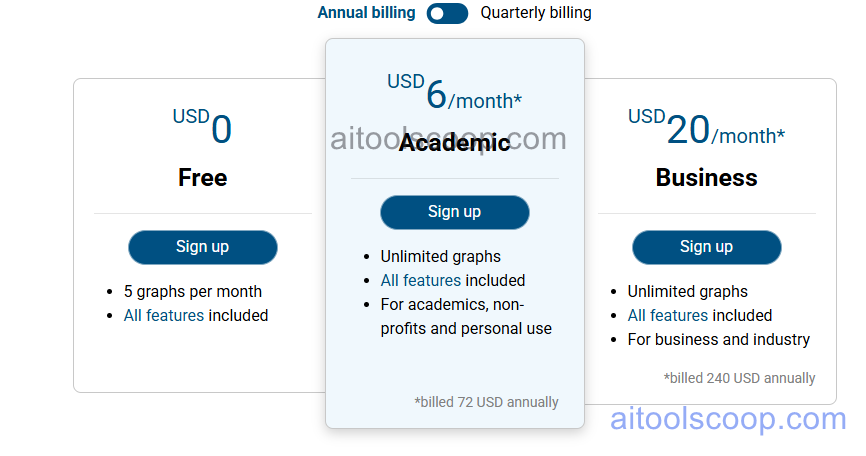
| Plan | Annual Price | Key Features |
|---|---|---|
| Free | $0/year | 5 graphs/month, full graph visualization, Prior & Derivative Works, paper metadata, shareable links |
| Academic | $6/year ($0.50/month) | Unlimited graphs, saved graph library, priority graph building, no ads, supports platform development |
| Institutional | $20/year ($1.67/month) | All Academic features, team library, shared workspaces, institutional billing, priority support |
Always check the latest rates on the official website. For more AI tool reviews, visit aitoolscoop.com.
Who Should Use Connected Papers?
Connected Papers is ideal for PhD students conducting systematic literature reviews to map their research field, academic researchers exploring unfamiliar territory to identify key papers and authors, professors building reading lists that capture a field's intellectual lineage, graduate students identifying gaps in existing research for dissertation topics, research librarians helping patrons navigate complex academic literatures, and interdisciplinary researchers discovering how concepts connect across fields. The free plan covers most casual users with 5 graphs per month, while the Academic plan at $6/year is one of the most affordable research tools available for power users.