Lokalise (lokalise.com) is a cloud-based localisation management platform founded in 2017 and headquartered in Riga, Latvia. It has rapidly grown into one of the leading enterprise localisation tools, particularly popular among product-led SaaS companies and mobile app teams who value a modern, developer-friendly workflow combined with strong integrations into content and design tools. Lokalise is used by companies including Revolut, Notion, and Stitch Fix to manage translation across mobile apps, web products, marketing content, and documentation.
Lokalise distinguishes itself through its broad and deep integration ecosystem — connecting to GitHub, GitLab, Bitbucket, Figma, Sketch, Contentful, Strapi, HubSpot, Zendesk, Intercom, and dozens more — and its modern, intuitive interface that makes localisation workflows accessible to both developers and non-technical content managers. Its AI capabilities include Lokalise AI, which provides machine translation, AI-powered translation review, automated quality assurance, and a conversational AI assistant that can answer localisation questions and suggest workflow improvements within the platform.
How Lokalise Works
Teams create a Lokalise project, connect their source repository or content platform via integration, and configure target languages. Source strings are imported automatically via the GitHub Action, CLI, or API. Lokalise AI generates machine translation drafts for all target languages instantly. Localisation managers assign translation tasks to team members, external freelancers, or language service providers through the workflow engine. Translators work in Lokalise's web editor, which shows TM suggestions, glossary terms, AI-generated alternatives, and screenshot context side by side. Approved translations are pushed back to the source system via the same integration — to the repository as a pull request, to the CMS as published content, or to Figma as updated design text.
Key Features
- Lokalise AI — machine translation, AI translation review, automated QA, and an in-platform AI assistant for localisation workflow guidance
- 50+ platform integrations — GitHub, GitLab, Bitbucket, Figma, Sketch, Contentful, Strapi, HubSpot, Zendesk, Intercom, and many more
- Developer CLI and API — command-line tool and REST API for integrating Lokalise into any CI/CD pipeline or custom development workflow
- Modern web translation editor — intuitive editor with TM matches, AI suggestions, glossary, screenshots, and in-context preview for translators
- Translation memory and glossary — organisation-wide TM and glossary enforce consistency and reduce costs across all projects and languages
- Workflow automation — configurable multi-step review and approval workflows with role-based access and automated task routing
- In-context editing — edit translations directly in a live website or app preview using Lokalise's in-context editor for visual accuracy
- Figma and Sketch plugins — extract design strings directly from design files and push them into Lokalise without manual copy-paste
- Over-the-air updates — push translation updates to live mobile apps without requiring a new app store release
- Analytics dashboard — project progress tracking, TM leverage reporting, and team activity metrics for localisation programme management
Lokalise Pricing
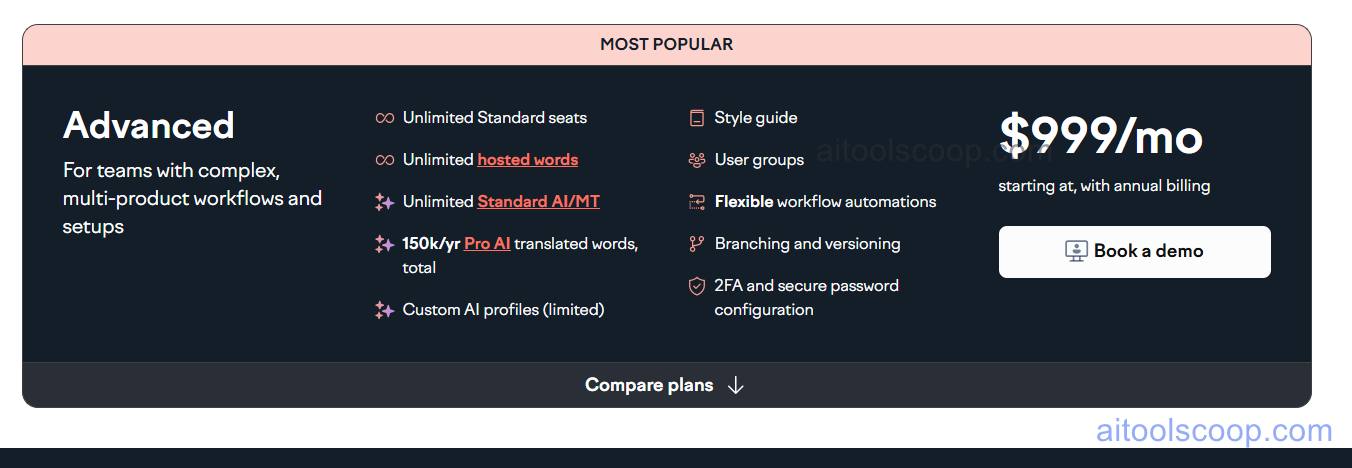
Lokalise is an enterprise localisation platform priced for product teams and organisations with active, ongoing localisation needs.
- From $999/month — full platform access including Lokalise AI, all integrations, developer CLI and API, translation memory, glossary, workflow automation, and analytics. Pricing scales with the number of seats, monthly active words, and selected add-ons. Custom enterprise plans are available for larger programmes.
A free trial is available. Always verify current rates and request a demo at lokalise.com/pricing.
Who Should Use Lokalise?
Lokalise is best suited to product-led SaaS companies, mobile app teams, and global content organisations that need a modern, integration-rich localisation platform with a developer-friendly workflow and strong non-technical usability. It is particularly strong for teams that use Figma or modern headless CMS platforms (Contentful, Strapi) alongside their development workflows. The starting price of $999/month positions Lokalise in the enterprise segment — it is not suited to individual developers, small startups, or teams with occasional localisation needs. Teams comparing Lokalise to Phrase or Transifex typically find Lokalise has the most modern interface and broadest integration ecosystem, while Phrase edges it on enterprise TMS workflow depth.
Frequently Asked Questions
What is Lokalise used for?
Lokalise is a localisation management platform used by product and engineering teams to translate mobile apps, web applications, marketing content, and documentation into multiple languages. It integrates with source code repositories, design tools, and content management systems to automate the flow of source strings into and approved translations out of the localisation workflow — keeping localisation in sync with product development.
How much does Lokalise cost?
Lokalise starts from $999 per month. Pricing scales based on the number of seats, monthly active words translated, and any additional modules or add-ons. Custom enterprise plans are available for larger organisations with higher volumes or specific requirements. A free trial is available to evaluate the platform before committing to a subscription.
What integrations does Lokalise support?
Lokalise offers more than 50 integrations including GitHub, GitLab, Bitbucket, Figma, Sketch, Contentful, Strapi, WordPress, HubSpot, Zendesk, Intercom, Jira, Slack, and many more. This breadth of integrations makes it possible to connect the localisation workflow directly to both development pipelines and content management systems without manual file export and import steps. A REST API and CLI are also available for custom integrations.
Does Lokalise support over-the-air translation updates?
Yes. Lokalise's over-the-air (OTA) update feature allows translation changes to be pushed to live mobile apps without submitting a new build to the App Store or Google Play. This is useful for fixing translation errors after launch, responding to user feedback in specific markets, or rolling out new languages incrementally. OTA updates are available as part of Lokalise's mobile SDK integration.
How does Lokalise differ from Phrase?
Both are enterprise-grade localisation platforms at a similar price point. Lokalise is generally praised for its modern, intuitive interface and broader ecosystem of integrations — especially for teams using modern headless CMS platforms, Figma, and SaaS tools like HubSpot and Zendesk. Phrase (which includes the former Memsource TMS) has deeper enterprise translation workflow management, a more established CAT editor, and stronger vendor and language service provider management features. Teams with complex multi-vendor translation programmes often prefer Phrase; product-led teams prioritising developer experience and integration breadth often prefer Lokalise.