
Transifex (transifex.com) is an enterprise-grade localisation and translation management platform founded in 2010 and based in San Francisco. It is one of the most established players in the software localisation space, used by companies including Atlassian, HubSpot, Eventbrite, and Waze to manage large-scale, continuous localisation programmes across mobile apps, web applications, APIs, and documentation. Transifex is built around the concept of continuous localisation — integrating translation directly into the software development lifecycle so that new strings are translated as soon as they are committed, rather than in separate translation sprints.
Transifex's AI features include Transifex AI, which uses large language model-based translation to generate high-quality machine translation drafts that outperform generic MT engines for software UI strings — preserving placeholders, HTML tags, and formatting codes that generic engines often corrupt. The platform also includes AI-powered translation memory leverage, glossary enforcement, and quality assurance checks that flag potential errors before strings go live. Transifex supports over 50 file formats and integrates with GitHub, GitLab, Bitbucket, Figma, and major CMS and e-commerce platforms.
How Transifex Works
Development teams connect Transifex to their source repository via the GitHub, GitLab, or Bitbucket integration, or upload source files directly via the CLI or API. Transifex AI generates translation drafts automatically for all target languages. Human translators — team members, freelancers, or language service providers — review and approve translations in Transifex's web editor, which provides full context, translation memory suggestions, glossary enforcement, and quality checks. Approved translations are pushed back to the repository automatically via the integration, triggering a pull request with the updated locale files. The entire cycle from new source string to approved translation can be automated to run continuously without manual handoff steps.
Key Features
- Transifex AI translation — LLM-based machine translation that preserves placeholders, HTML tags, and formatting codes in software strings
- Continuous localisation — automated pipeline that translates new strings as soon as they are pushed to the source repository
- GitHub, GitLab, and Bitbucket integration — bidirectional repository sync for automatic string upload and translated file pull request creation
- 50+ file format support — JSON, XLIFF, PO/POT, Android XML, iOS .strings, YAML, CSV, HTML, Markdown, and many more
- Figma integration — extract and translate design strings from Figma alongside code strings in the same project
- Translation memory — leverages previously approved translations to reduce redundant translation work and maintain consistency
- Glossary and terminology management — define brand terms, product names, and key vocabulary to enforce consistent translation across all languages
- AI quality assurance — automated QA checks flagging missing placeholders, inconsistent terminology, punctuation errors, and formatting issues
- Workflow automation — configurable review and approval workflows with role-based access for translators, reviewers, and managers
- Analytics and reporting — translation progress dashboards, team productivity metrics, and quality score reporting
Transifex Pricing
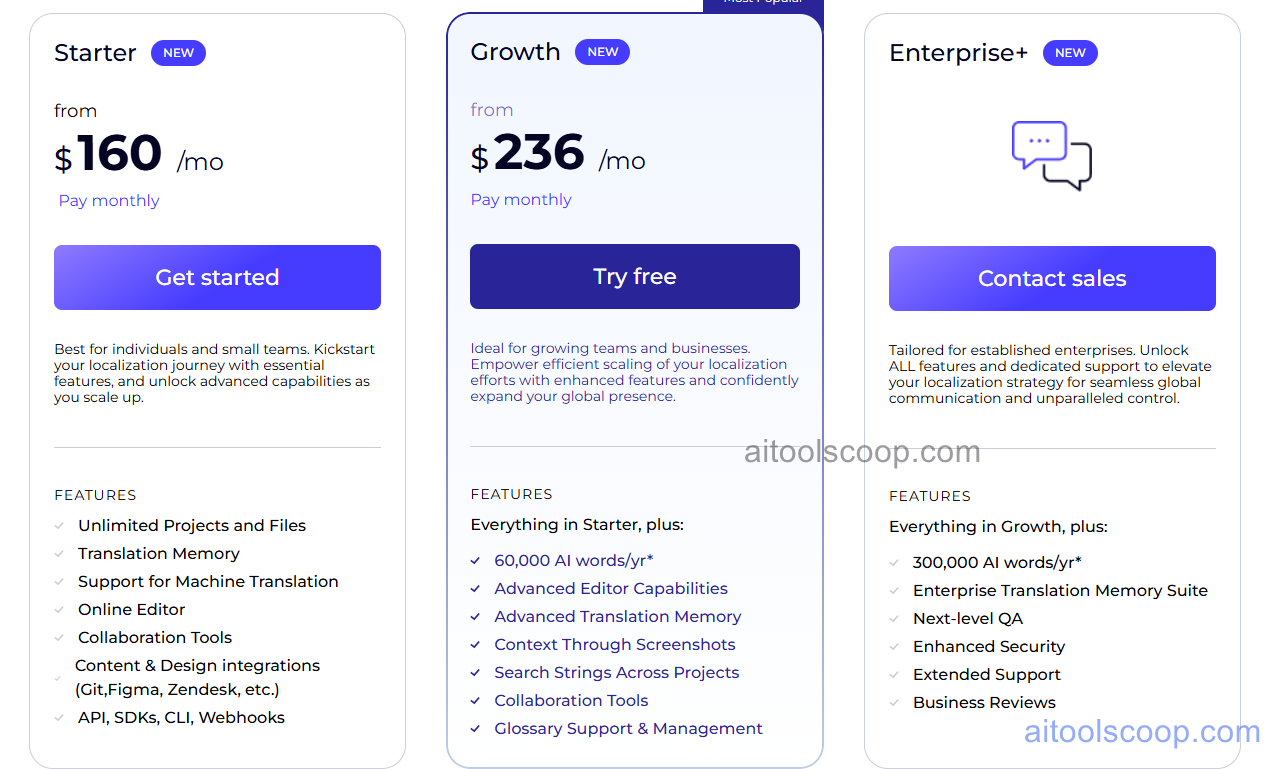
Transifex offers two main subscription plans with annual billing discounts. Enterprise plans with custom pricing are available for large organisations.
- Starter — $160/month (annual: $135/month) — full platform access including Transifex AI, continuous localisation, GitHub/GitLab/Bitbucket integration, 50+ file formats, translation memory, glossary, QA checks, and team collaboration.
- Growth — $236/month (annual: $200/month) — everything in Starter plus higher project and resource limits, advanced workflow automation, expanded team seats, and priority support.
Enterprise plans with custom pricing are available for large-scale programmes. Always verify current rates at transifex.com/pricing.
Who Should Use Transifex?
Transifex is best suited to product and engineering teams at mid-size to large software companies that run continuous, high-volume localisation programmes across multiple products and many target languages. Its continuous localisation approach, deep repository integrations, and enterprise-grade workflow automation make it particularly valuable for agile development teams where localisation needs to keep pace with weekly or daily releases. The starting price of $135/month (annual) positions it in the mid-market and above — individual developers and early-stage startups will likely find OneSky, Localazy, or Weglot more cost-appropriate. Open-source projects may qualify for Transifex's free open-source programme.
Frequently Asked Questions
What is Transifex used for?
Transifex is a localisation and translation management platform used by software product teams to manage continuous translation of mobile apps, web applications, APIs, and documentation. It integrates directly with GitHub, GitLab, and Bitbucket so new source strings are translated automatically as they are committed, keeping localisation in sync with software development without separate translation sprints or manual file handling.
How much does Transifex cost?
Transifex's Starter plan costs $160/month ($135/month billed annually) and the Growth plan costs $236/month ($200/month annually). Enterprise plans with custom pricing are available for large organisations. Annual billing saves approximately 15–16% compared to monthly. There is no permanently free commercial plan, though an open-source programme offers free access to qualifying projects.
What is Transifex AI and how does it differ from standard machine translation?
Transifex AI uses large language model-based translation specifically tuned for software UI strings. Unlike generic machine translation engines, Transifex AI is designed to preserve software-specific formatting — placeholders like {username} or %s, HTML tags, ICU message format syntax, and other string interpolation patterns — that generic MT engines frequently corrupt or remove. It also leverages the project's translation memory and glossary to align output with previously approved terminology, producing drafts that require less post-editing than generic MT for software localisation use cases.
Does Transifex support continuous localisation?
Yes. Continuous localisation is one of Transifex's core design principles. By integrating directly with source code repositories, Transifex can detect new or changed strings as soon as they are committed, automatically generate translation drafts, route them through the configured review workflow, and push approved translations back to the repository — all without manual intervention. This allows localisation to run in parallel with development rather than as a separate upstream or downstream process.
How does Transifex compare to Phrase or Lokalise?
Transifex, Phrase, and Lokalise are all enterprise-grade localisation platforms with overlapping capabilities. Transifex has one of the longest track records and a strong open-source community heritage. Phrase (formerly Phrase Strings) is known for its depth of workflow customisation and enterprise feature set. Lokalise is often cited for its modern UI and strong integrations ecosystem. All three support continuous localisation, AI translation, and repository integrations. The best choice depends on specific workflow requirements, team size, and preferred pricing structure — evaluating each with a trial or demo is recommended for enterprise teams.