
Home/ AI Tools /AI Audio & Voice /Cartesia
Cartesia Freemium
🤖 AI Audio & Voice
#24 in AI Audio & Voice

Cartesia

Cartesia is an ultra-low latency real-time text-to-speech API built for voice agents and interactive applications. Sub-80ms synthesis latency, voice cloning, and streaming output. Free plan available. Pro from $49/month.

4.0 / 5 Freemium From $5/mo
Quick Info
💰 Pricing$5/mo
⭐ Rating4.0 / 5
🆓 Free Plan✅ Yes
📂 CategoryAI Audio & Voice
🌐 WebsiteVisit ↗
🕐 Last UpdatedApr 4, 2026
🔀 Alternatives26 tools
Verified Data Updated Apr 4, 2026
Independently Reviewed No paid placements
Detailed Analysis Hands-on testing
Key Features
  • Sub-80ms end-to-end synthesis latency for real-time voice agent deployment
  • Streaming token input — accepts LLM output token-by-token before sentence completes
  • Voice cloning from short audio samples for custom branded personas
  • Emotion and style controls — pace, tone, and expressiveness via API
  • Multi-language support with English-first optimization
  • Commonly paired with Deepgram ASR to build a full duplex voice pipeline
4.0
Overall Rating
Ease of Use
4.2
Features
4.0
Value
3.7
Performance
4.1
Support
3.9
Pros & Cons
👍 Pros
  • Industry-leading sub-80ms latency — best available for real-time voice agents
  • Streaming input eliminates sentence-completion wait time
  • Voice cloning available from Pro tier
  • Clean, well-documented API with fast integration
  • Flexible pricing from $4/month for small projects
👎 Cons
  • Language support beyond English is still maturing
  • Free tier quota is limited for meaningful load testing
  • Does not include ASR — must be combined with Deepgram or equivalent
  • Scale tier pricing jumps significantly from Pro
📖

About Cartesia

Cartesia (cartesia.ai) is a real-time speech synthesis platform engineered for latency-critical applications. Where most TTS APIs are optimized for batch audio generation, Cartesia is purpose-built for conversational AI — phone agents, voice assistants, and real-time interactive experiences where the gap between the LLM finishing a sentence and the user hearing it must be measured in milliseconds, not seconds.

How Cartesia Works

Cartesia's Sonic model uses a state space architecture (rather than transformer-based diffusion) to deliver streaming audio output with end-to-end latency under 80ms. You send text to the API — either full sentences or streaming token-by-token as the LLM generates them — and receive a PCM or Opus audio stream back in real time. The API integrates directly into voice agent stacks, typically paired with a speech recognition provider like Deepgram on the input side to complete a full duplex voice pipeline.

Key Features

  • Sub-80ms synthesis latency — purpose-built for real-time voice agent deployment
  • Streaming token input — accepts LLM token streams directly, eliminating sentence-completion wait time
  • Voice cloning — create custom voices from short audio samples for branded agent personas
  • Emotion and style control — adjust speaking pace, tone, and expressiveness via API parameters
  • Multi-language support — English-first with expanding language coverage
  • Pairs with Deepgram ASR — commonly integrated alongside Deepgram for a complete speech-in / speech-out pipeline

Cartesia Pricing
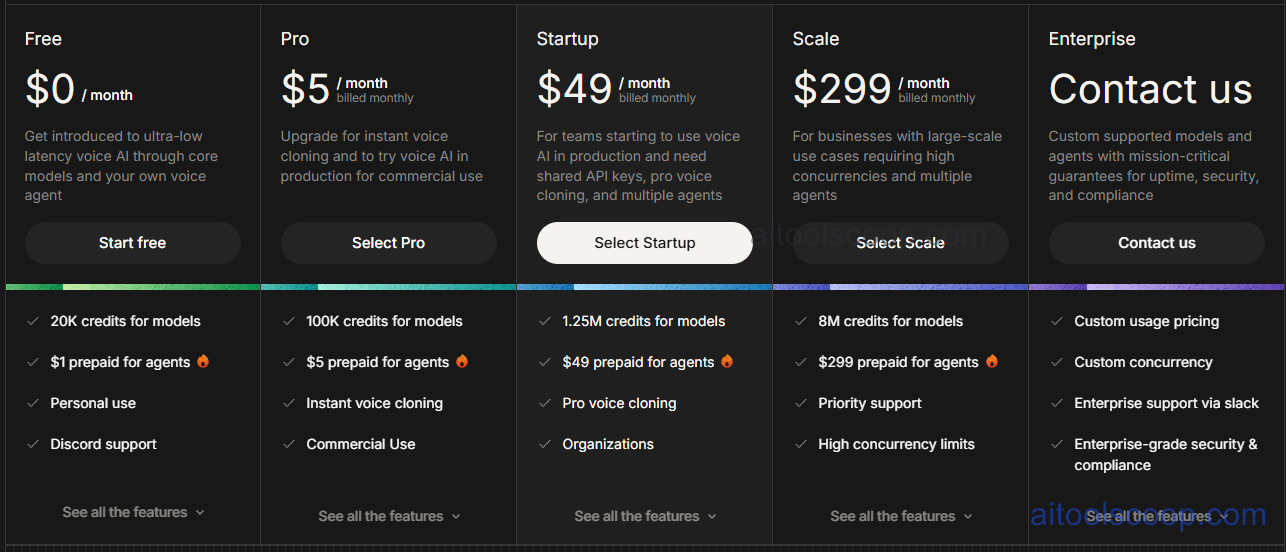
Cartesia Sonic AI Voice Pricing, API Usage Fees, Character-Based Billing and Enterprise Developer Tiers
Cartesia: Real-Time Voice API Infrastructure Pricing
  • Free — $0/month — Limited character quota for testing and evaluation.
  • Starter — $5/month — Modest character allowance for small projects and side builds.
  • Pro — $49/month — Higher quota, voice cloning access, and priority API throughput.
  • Scale — $299/month — High-volume production quota with dedicated support and SLA commitments.Pricing is subject to change. Always check the latest rates on the official website. For more AI tool reviews, visit aitoolscoop.com.

Who Should Use Cartesia?

Cartesia is the right TTS layer for developers building real-time voice agents — whether on Retell AI, Vapi, LiveKit, or a custom WebRTC stack. If your use case involves a phone agent or interactive voice assistant where latency determines whether the conversation feels natural or robotic, Cartesia's sub-80ms pipeline is the current state of the art. It is typically combined with Deepgram for speech recognition to form a complete real-time voice pipeline without writing low-level audio infrastructure.


💰

Pricing Plans

Plan Price Includes
Pro $5/mo Full access + priority support
Check Current Pricing →
Affiliate Disclosure: This page contains affiliate links. If you click and make a purchase, we may earn a small commission at no extra cost to you. We only recommend tools we genuinely believe in.

🎯 Explore More

Discover other curated resources from our platform

🛠️ AI Tools View All →
Anyword
Anyword
★ 4.1
Motion
Motion
★ 4.4
PicsArt
PicsArt
★ 4.3
⚔️ VS Comparisons View All →
ChatGPT vs Gemini: Which AI Writing Tool Wins in 2026?
ChatGPT vs Gemini: Which AI Writing…
ChatGPT vs Gemini: 2026 Comparison — Pricing, Features & Verdict
ChatGPT vs Gemini: 2026 Comparison —…
ChatGPT vs Gemini
⚔️
ChatGPT vs DeepSeek: Which AI Is…
ChatGPT GPT-4o vs DeepSeek R1
💡 Free Prompts View All →
💡
Claude for Hospitality Destination Marketing Managers:…
🔥 4.4K uses
💡
Claude Prompts for Hospitality CX Directors:…
🔥 0.4K uses
💡
Intermediate Guide: Fix Poor Mobile SEO…
🔥 4.9K uses
💡 Free Prompts