Moonshot AI's Long-Context Model for Research and Analysis
Kimi (kimi.com) is the consumer AI assistant developed by Moonshot AI, a Chinese AI company. It runs on the Kimi K2.5 model, released in January 2026, which uses a Mixture-of-Experts architecture with 1 trillion total parameters and 32 billion activated per request. The headline capability is Agent Swarm technology: an orchestrator that coordinates up to 100 specialized sub-agents working simultaneously, reducing execution time on complex tasks by up to 4.5x compared to sequential AI processing. On the Humanity's Last Exam benchmark, Kimi K2.5 achieves 50.2% at 76% lower cost than comparable frontier models.
What Is Kimi?
Kimi is accessible via kimi.com for browser chat, the Kimi mobile app, the Moonshot API at platform.moonshot.ai, and Kimi Code as a CLI tool for coding workflows. The consumer platform handles text, images, documents, voice, and web search. For developers, the Kimi API is OpenAI-compatible — meaning existing OpenAI SDK integrations can switch to the Moonshot endpoint (api.moonshot.ai/v1) with minimal changes.
Kimi originated in China and is primarily optimized for Chinese-language use, but the platform at kimi.com is available in English and supports multiple languages. Moonshot is actively expanding international availability.
Who Makes Kimi?
Kimi is developed by Moonshot AI, a Chinese AI company. The K2.5 model is open-source and was pre-trained on 15 trillion tokens using a novel training stack including the MuonClip optimizer for stable large-scale MoE training. The model was developed using Parallel-Agent Reinforcement Learning (PARL) to train the Agent Swarm coordination capability specifically. API infrastructure is provided through Volcano Engine, ByteDance's cloud platform.
Key Features
- Agent Swarm — Coordinates up to 100 parallel sub-agents on complex tasks. BrowseComp benchmark: 78.4% (Agent Swarm) vs 60.6% (standard). Wide Search: 79.0% vs 72.7% standard. Reduces execution time by 4.5x for tasks requiring broad information gathering
- 256K context window — Handles large documents, long conversations, and complex codebases without losing earlier context
- Native multimodal — Vision and language capabilities developed together from training, not as separate grafted features. Handles images and text natively
- Deep Research mode — Multi-step autonomous research that synthesizes from multiple sources with citations
- OK Computer agent — Browses the web, uses tools, and executes code to fulfill user requests autonomously
- K2 Thinking mode — Extended reasoning for complex math, coding, and logical problems
- Automatic context caching — API-level feature that reduces input costs by 75% on repeated context. No configuration required
- Web search integration — Real-time web search built into both the consumer app and the API (at $0.005 per call plus token costs)
Pricing
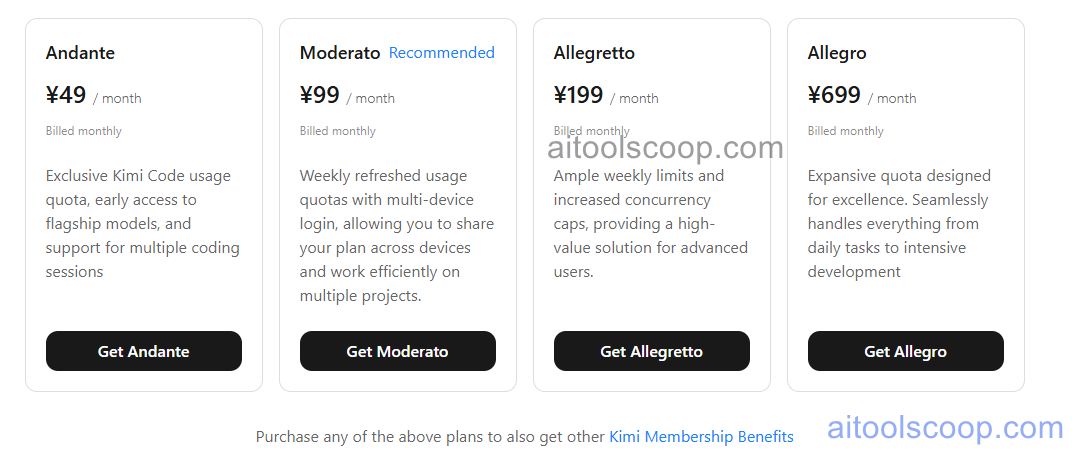
Pricing is subject to change. Always check the latest rates on the official website. For more AI tool reviews, visit aitoolscoop.com.
Consumer app (kimi.com):
- Free (Adagio) — Unlimited basic conversations. Limited monthly Deep Research and OK Computer agent runs
- Andante — approximately $19/month (international) — Moderate allotment of Deep Research sessions and OK Computer agent runs per month. Chinese equivalent: ¥49/month
- Moderato — approximately $39/month (international) — Higher monthly Deep Research and agent quotas. Chinese equivalent: ¥99/month. API usage fees not included in membership
Developer API (platform.moonshot.ai):
- K2 standard — $0.60/million input tokens, $2.50/million output tokens. Cached tokens: $0.15/million input (75% reduction)
- Minimum recharge — $1 to activate account. First $5 recharge receives a $5 bonus voucher
Kimi vs Competitors
Kimi K2.5's clearest advantage over GPT-5.2 and Claude Opus 4.5 is cost: API pricing at $0.60/$2.50 per million tokens is significantly below OpenAI and Anthropic pricing for comparable capability. On agentic benchmarks specifically (BrowseComp, Wide Search), Kimi K2.5 leads GPT-5.2 (74.9% vs 59.2%). For single-task reasoning on some benchmarks, GPT-5.2 scores higher. Gemini has stronger Google ecosystem integration. For developers building agentic applications who need cost efficiency, Kimi K2 is the most compelling option in early 2026. For Chinese-language enterprise use cases, Kimi is the dominant platform.
Pros & Cons
Pros:
- Agent Swarm technology for parallel task execution — a genuine technical differentiator
- API pricing significantly below OpenAI and Anthropic for comparable capability
- Automatic context caching reduces API costs by 75% with no configuration
- Open-source K2.5 model available for self-hosting
- OpenAI-compatible API for easy integration
Cons:
- Primarily optimized for Chinese-language use — English-language specialized tasks may lag behind Western competitors
- Independent benchmarks for K2.5's claimed performance are still being evaluated by the research community
- Consumer app features (Deep Research, OK Computer) available in limited quantities on free tier
- Data handling subject to Chinese regulatory requirements — relevant for enterprise users outside China
Who Should Use Kimi?
Kimi is the right choice for developers building agentic applications who need cost-efficient API access to a capable frontier model, teams working primarily in Chinese, and researchers evaluating open-source MoE architectures. For international users, kimi.com is accessible and English-capable. For enterprise use cases involving sensitive data outside China, verify data handling requirements against your organization's compliance needs before deployment.
Bottom Line
Kimi K2.5 is the most cost-efficient frontier-quality AI model available via API in early 2026, with Agent Swarm technology that leads on agentic benchmarks. For developers, the OpenAI-compatible API and automatic context caching make it a straightforward evaluation. For consumer use, the free tier is functional for everyday tasks and the paid tiers unlock the more intensive agent features.