Open-Source AI Agent Framework for Developers
SuperAGI (superagi.com) is an open-source autonomous AI agent framework and cloud platform for building, managing, and deploying AI agents that execute complex multi-step workflows autonomously. Designed for developers and technical teams, SuperAGI provides the infrastructure for creating agents that can browse the web, write and execute code, manage files, send emails, interact with APIs, and complete long-horizon tasks with minimal human supervision. The platform supports multiple LLMs (GPT-4, Claude, Gemini, and open-source models), concurrent agent execution, and a growing marketplace of pre-built agent tools and integrations. Organizations use SuperAGI to automate research workflows, software development tasks, data analysis pipelines, and content generation processes at scale.
How SuperAGI Works
Deploy SuperAGI via the cloud platform or self-host using the open-source Docker setup. Create an agent by defining its goal in natural language, selecting the underlying LLM, and configuring its tool access — web browser, code interpreter, file manager, email sender, API connector, or database tools. Set agent constraints including budget limits, execution time, and output requirements. Launch the agent and SuperAGI's orchestration layer breaks the goal into sub-tasks, selects appropriate tools for each step, executes actions, evaluates results, and iterates until the objective is achieved. Monitor agent runs in real time through the Agent Dashboard showing each action taken, tool called, and output produced. Chain multiple agents together for complex workflows where one agent's output feeds the next. Use the Marketplace to discover and add community-built tools and agent templates. Deploy production agents with scheduling, webhooks, and API triggers.
Key Features
- Autonomous agent execution — agents complete multi-step goals without human intervention
- Multi-LLM support — GPT-4, Claude, Gemini, Llama, and other models selectable per agent
- Concurrent agents — run multiple agents simultaneously for parallel workflow execution
- Tool marketplace — extensible library of community-built agent tools and integrations
- Code interpreter — agents write, execute, and debug code autonomously
- Web browsing — agents navigate and extract data from websites in real time
- Agent chaining — connect agents in sequence for complex multi-stage pipelines
- Open-source core — self-hostable with full code transparency and community contributions
- Agent monitoring — real-time dashboard showing step-by-step execution logs
- API and webhook triggers — integrate agent execution into external systems and workflows
SuperAGI Pricing
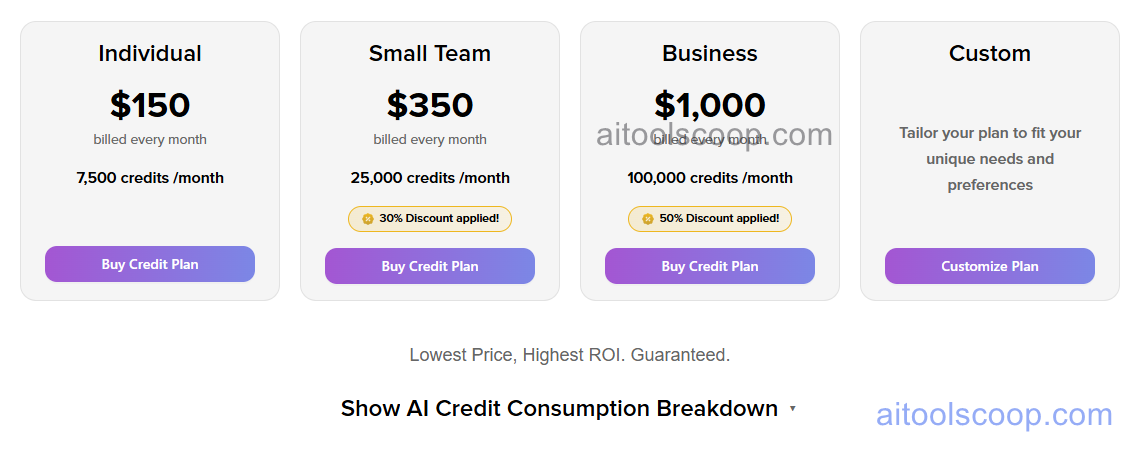
| Plan | Monthly Price | Key Features |
|---|---|---|
| Open Source | Free (self-hosted) | Full framework, all features, self-host on own infrastructure, community support |
| Starter | $150/month | Cloud hosting, 5 concurrent agents, managed infrastructure, basic support, tool marketplace |
| Pro | $350/month | 20 concurrent agents, priority processing, API access, advanced monitoring, team collaboration |
| Enterprise | $1,000/month | Unlimited agents, dedicated infrastructure, SSO, SLA, custom integrations, dedicated support |
| Custom | Custom pricing | Private cloud deployment, custom SLA, dedicated engineering, white-label, advanced security |
The open-source version is freely available on GitHub and can be self-hosted at no cost. Always check the latest rates on the official website. For more AI tool reviews, visit aitoolscoop.com.
Who Should Use SuperAGI?
SuperAGI is ideal for software development teams automating code review, testing, and documentation workflows, research organizations building automated data collection and analysis pipelines, technical founders prototyping AI-powered product features without extensive AI infrastructure, DevOps teams automating repetitive system administration and monitoring tasks, data engineering teams orchestrating complex multi-step data processing workflows, and enterprises exploring autonomous AI capabilities with the flexibility of open-source infrastructure. Self-hosting via the open-source version suits privacy-conscious developers and organizations with DevOps capacity, while cloud plans serve teams prioritizing managed infrastructure over infrastructure management.