LangChain is the most widely adopted open-source framework for building AI agents and LLM-powered applications. Over 128,000 GitHub stars. Free to use. LangSmith observability platform from $0/month (Developer) to $39/user/month (Plus).
LangGraph adds complexity over simple chain patterns
Free tier data retention only 14 days
📖
About LangChain
LangChain (langchain.com) is an open-source framework for building applications powered by large language models. Released in October 2022, it has become the de facto standard for connecting LLMs to external tools, data sources, and memory systems. As of early 2026, the project has accumulated over 128,000 GitHub stars — one of the most starred AI repositories in history. LangChain's 2026 strategic focus has shifted decisively from chains to agents: LangGraph, its stateful agent orchestration framework, has reached general availability as the primary tool for building production-grade multi-actor agent systems.
What Is LangChain and How Does It Work?
LangChain is a composable framework: you connect LLMs, prompts, memory systems, retrievers, tools, and output parsers into agents and pipelines using a unified interface. The framework abstracts away provider-specific APIs, giving you a consistent development experience whether you're using GPT-4o, Claude 3.5 Sonnet, Gemini, or a local Llama model. The architecture is organized into distinct layers: langchain-core defines the base abstractions and interfaces; integration packages (langchain-openai, langchain-anthropic, langchain-community) provide concrete implementations for specific providers; and LangGraph sits alongside as the dedicated framework for stateful, multi-actor agent workflows.
The core concept is the Runnable — a composable unit that can be chained, parallelized, and transformed using LangChain Expression Language (LCEL). Everything from a simple LLM call to a multi-step RAG pipeline is expressed as a Runnable chain, making composition consistent and debuggable.
LangChain vs LangGraph: Understanding the Difference
Many developers conflate LangChain and LangGraph, but they serve different purposes. LangChain provides the integrations, abstractions, and tooling for building LLM applications — it's the foundation layer. LangGraph is built on top of LangChain and provides the agent orchestration layer: it models agent workflows as directed graphs with nodes, edges, and shared state, enabling complex patterns like branching logic, loops, human-in-the-loop interrupts, and multi-agent coordination that simple chain executors cannot support.
For 2026, LangChain's own documentation recommends LangGraph for any production agent that needs to maintain state, handle long-running tasks, or coordinate multiple specialized sub-agents. The create_agent function provides a proven ReAct pattern running on LangGraph's durable runtime, giving developers a fast starting point without having to design the agent architecture from scratch.
Key Features of LangChain in 2026
RAG Pipeline Support
Retrieval-Augmented Generation is LangChain's strongest suit. The framework includes document loaders, text splitters, embedding model integrations, vector store connectors, and contextual compression into a mature, well-documented pipeline. LangChain supports over 100 document formats and 50+ vector databases, giving teams significant flexibility in their data infrastructure choices. For teams building knowledge bases, document Q&A systems, and semantic search applications, LangChain's RAG primitives substantially reduce development time compared to building from scratch.
Agent and Tool Use
LangChain supports ReAct, OpenAI Functions/Tools, and structured tool calling agent patterns. Agents can use web search, code execution, file systems, APIs, databases, and custom Python functions as tools. The framework handles tool calling loops, error handling, and output parsing. LangChain ships with 1,000+ integrations, covering virtually every LLM provider, vector store, and external service a production team is likely to need — and eliminates vendor lock-in since you can swap providers without rewriting application logic.
Durable Runtime via LangGraph
LangChain agents run on LangGraph's durable runtime, providing built-in persistence, rewind, checkpointing, and human-in-the-loop support. This matters for production agents: unlike simple stateless API calls, agents can pause mid-execution waiting for human approval, recover from failures without losing progress, and maintain conversation context across sessions without custom memory management.
Deep Agents (2026)
New in 2026, LangChain introduced Deep Agents — a pattern for complex, long-running tasks that uses planning, memory, and sub-agents. Deep Agents are designed for workflows that exceed what a single ReAct loop can handle: multi-day research tasks, complex data processing pipelines, and coordination across multiple specialized agents each responsible for a specific domain.
Middleware and Customization
One of LangChain's architectural strengths is its middleware system. You can extend agent behavior — adding human-in-the-loop approval, compressing long conversations, or removing sensitive data — through composable hooks without rewriting core agent logic. This makes it practical to add enterprise requirements like audit trails, PII scrubbing, and cost controls to existing agents incrementally.
LangSmith: Observability, Evaluation, and Deployment
LangSmith is LangChain's commercial observability and evaluation platform, available at smith.langchain.com. It captures every LLM call, tool invocation, and chain execution with full input/output logging, breaking each agent run into a structured timeline of steps so you can see exactly what happened, in what order, and why.
LangSmith also provides evaluation datasets and regression testing: capture production traces, turn them into test cases, and score agents with a mix of human review and automated evals. C.H. Robinson, a logistics company, used LangSmith to automate 5,500 orders per day, saving 600+ hours daily — one of the more concrete real-world outcomes LangChain has published. LangSmith is framework-agnostic: it works with LangGraph, direct API calls, or any other agent framework, not only with LangChain.
LangChain Pricing
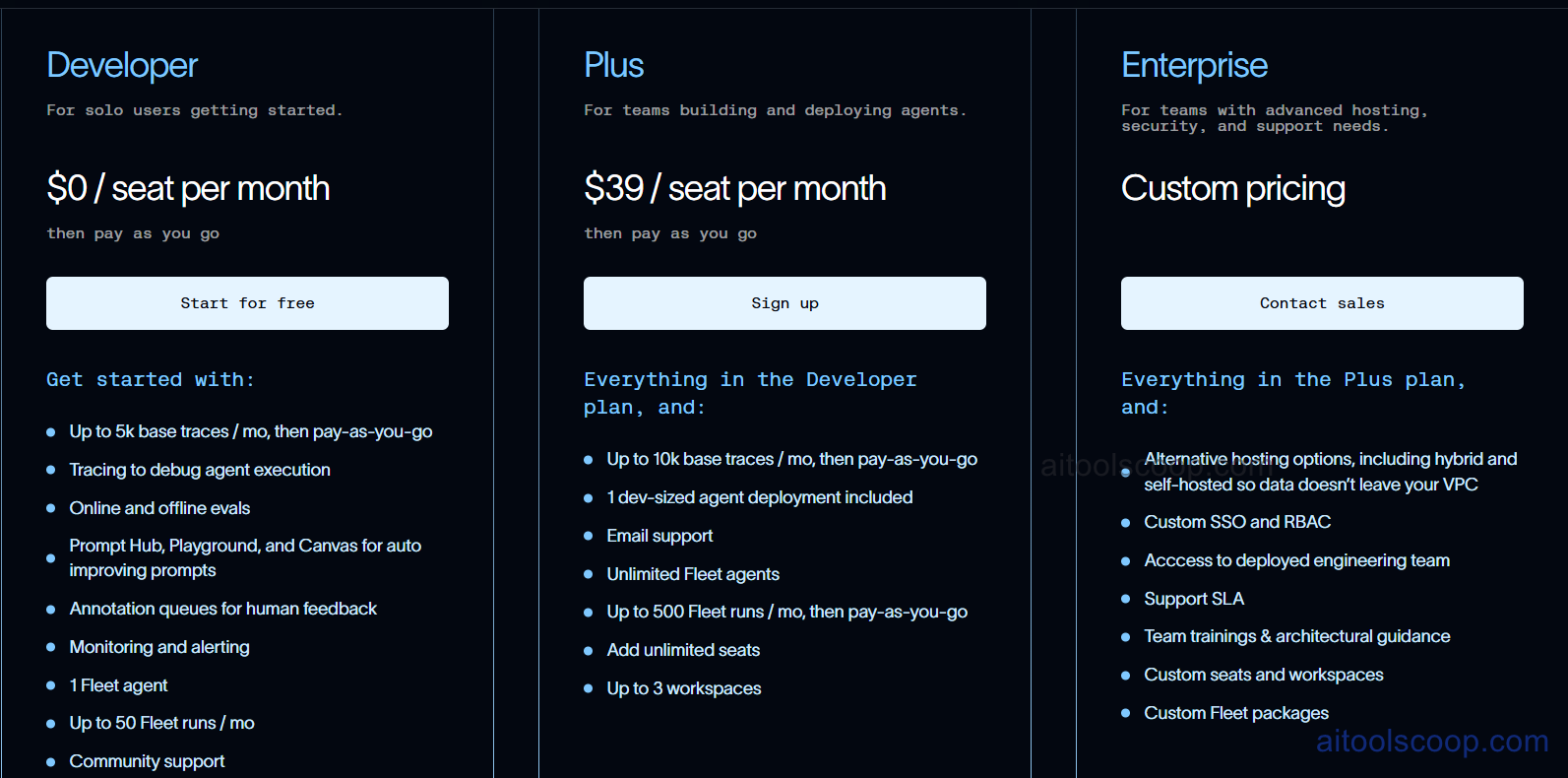
LangChain: Pricing for LLM app development platform
Pricing is subject to change. Always check the latest rates on the official website. For more AI tool reviews, visit aitoolscoop.com.
LangChain Framework — Free (MIT license) — The open-source library is free to use without restriction. You pay only for the LLM API calls your application makes to providers like OpenAI, Anthropic, or Google. There is no cost associated with the framework itself.
LangSmith Developer — Free — 1 seat, 5,000 base traces/month. Sufficient for individual development and testing. Community-based support via LangChain Slack. Data retention on the free tier is 14 days — a practical limitation for debugging issues that surfaced more than two weeks ago.
LangSmith Plus — $39/user/month — 10,000 base traces/month included, with usage-based billing for additional traces. 1 free dev-sized LangSmith Deployment included. Preferential support via support.langchain.com. Recommended for teams of 2–10 actively building and deploying agents.
LangSmith Enterprise — custom pricing — Advanced administration, SSO, HIPAA/SOC 2 compliance, self-hosted or BYOC deployment options, dedicated customer success manager, and unlimited traces. LangSmith is SOC 2 Type II, GDPR, and HIPAA compliant. Contact LangChain sales for enterprise pricing.
Startup Plan — Discounted rates and generous free trace allotments for early-stage companies building agentic applications. Available for companies with less than $10M in funding that have raised at least $25K in seed funding (Build tier), or Series A or earlier stage companies backed by a LangChain premier VC partner (Scale tier).
Cost caveat: LangChain apps tend to use more LLM calls than simpler architectures. Chain-of-thought, retrieval, and agent loops multiply your API costs. A pipeline that makes 5 LLM calls per user request costs 5x more in model API fees than a single direct call. Budget for this when estimating production costs.
LangChain vs Alternatives: When to Use Which
LangChain vs LlamaIndex
LlamaIndex is more narrowly focused on data indexing and retrieval — it excels at RAG pipelines and knowledge base construction. LangChain covers a broader surface area including agents, tool calling, memory, and multi-step chains. Teams building primarily document Q&A and search applications may find LlamaIndex's RAG primitives more ergonomic. Teams building production agents with complex tool use, branching logic, and multi-actor coordination will find LangChain + LangGraph more capable.
LangChain vs CrewAI
CrewAI provides a higher-level abstraction for multi-agent systems using a role-based team metaphor (agents have "roles," "goals," and "backstories"). It's faster to get a multi-agent demo working in CrewAI than in LangGraph, but LangGraph offers more precise control over state management and agent coordination. CrewAI is built on top of LangChain, so the two are complementary rather than competing — many teams prototype in CrewAI and then migrate to LangGraph for production control.
LangChain vs AutoGen
Microsoft's AutoGen focuses specifically on multi-agent conversation patterns, particularly code generation and execution workflows. LangChain is more general-purpose. AutoGen has stronger built-in support for code-writing agents; LangChain has a broader ecosystem and more mature RAG support.
Who Should Use LangChain?
LangChain is the right choice for Python and JavaScript developers building production LLM applications who need flexibility, a broad ecosystem, and the ability to swap providers without rewriting application logic. It is well suited for teams building RAG systems, document processing pipelines, knowledge base Q&A, and autonomous agents. The framework is less appropriate for non-technical users (who should look at no-code agent builders), teams that want highly opinionated multi-agent patterns with minimal setup (CrewAI serves this use case), or applications where a single direct API call is sufficient and the orchestration overhead is unnecessary.
According to LangChain's 2026 State of Agent Engineering survey of 1,300+ professionals, 57% of respondents have agents in production, with large enterprises leading adoption. Quality is the top production barrier, cited by 32% of respondents, while 89% have implemented observability for their agents. These numbers reflect both the maturity of the space and the practical challenges of running agents reliably at scale — both areas where LangChain's tooling is specifically designed to help.
Bottom Line
LangChain remains the most practical starting point for developers building LLM-powered agents in 2026. The open-source framework is free, the 128,000+ GitHub star community produces a constant stream of integrations and examples, and the LangGraph layer handles stateful agent complexity that simpler frameworks cannot. The main cost consideration is not the framework itself but the LLM API calls your agents make — design your pipelines with call efficiency in mind from the start. For teams that need production observability, LangSmith's Plus plan at $39/user/month is straightforward value once you're handling real traffic.
Affiliate Disclosure: This page contains affiliate links. If you click and make a purchase, we may earn a small commission at no extra cost to you. We only recommend tools we genuinely believe in.
🎯 Explore More
Discover other curated resources from our platform
 Freemium