

v0 (v0.app), formerly v0.dev, is Vercel's AI-powered application builder that generates production-ready React and Next.js code from natural language prompts. Launched in October 2023 as a UI component generator and rebranded to v0.app in January 2026 to reflect its evolution into a full-stack development environment, v0 has grown to over 6 million developers on the platform. Vercel — the company behind Next.js and the infrastructure powering much of the modern web — is valued at $9.3 billion with investors including Accel, GV (Google Ventures), and Greenoaks Capital.
In 2026, v0 is no longer just a component scaffolding tool. The new sandbox-based runtime can import any GitHub repository, pull Vercel environment variables automatically, and build complete applications inside a live environment. The code lives in your repo. You work through a Git panel that creates branches per chat and opens pull requests against main — meaning non-engineers can ship production code through proper version-controlled workflows for the first time.
What v0 Actually Generates
v0 outputs production-ready React components using shadcn/ui, Tailwind CSS, and Next.js conventions by default — the same stack used by most modern React production applications. The generated code is clean enough to deploy directly, not just to use as a starting point. For frontend developers on a Next.js + Tailwind stack, v0 eliminates approximately 70% of the repetitive frontend work: component structure, responsive layout, variant states, accessibility attributes, and TypeScript typing are all handled automatically.
For non-developers, the new agentic mode handles more of the complexity autonomously. It plans work step by step, checks its own output for errors, searches the web when it needs context, and iterates without requiring manual re-prompting for corrections. Product managers can go from a user story to a functional dashboard with charts, filters, and test data. Marketers can edit landing pages, change images, and fix copy without opening a ticket.
Key Features
- Production-ready React/Next.js code generation — shadcn/ui + Tailwind CSS + TypeScript by default, deployable without cleanup
- Sandbox-based runtime — import any GitHub repo, pull Vercel environment variables automatically, build in a live environment
- Git panel — create branches per chat, open PRs against main, deploy on merge; non-engineers can ship through proper git workflows
- Agentic mode — plans work, checks errors, searches the web, and iterates automatically with fewer re-prompts
- Figma import — upload a Figma design and v0 generates the working React implementation (Premium plan and above)
- Database integrations — Snowflake, AWS, and other enterprise data sources connectable directly from the build environment
- One-click Vercel deployment — automatic SSL, CDN, and serverless functions included; deploy from v0 to production in seconds
- iOS app — build and iterate from mobile with the v0 iOS app
v0 Pricing
Source: v0.app/pricing, verified March 2026. v0 uses token-based billing — generation cost varies by complexity. Simple components cost less; full-stack app generations consume more tokens.
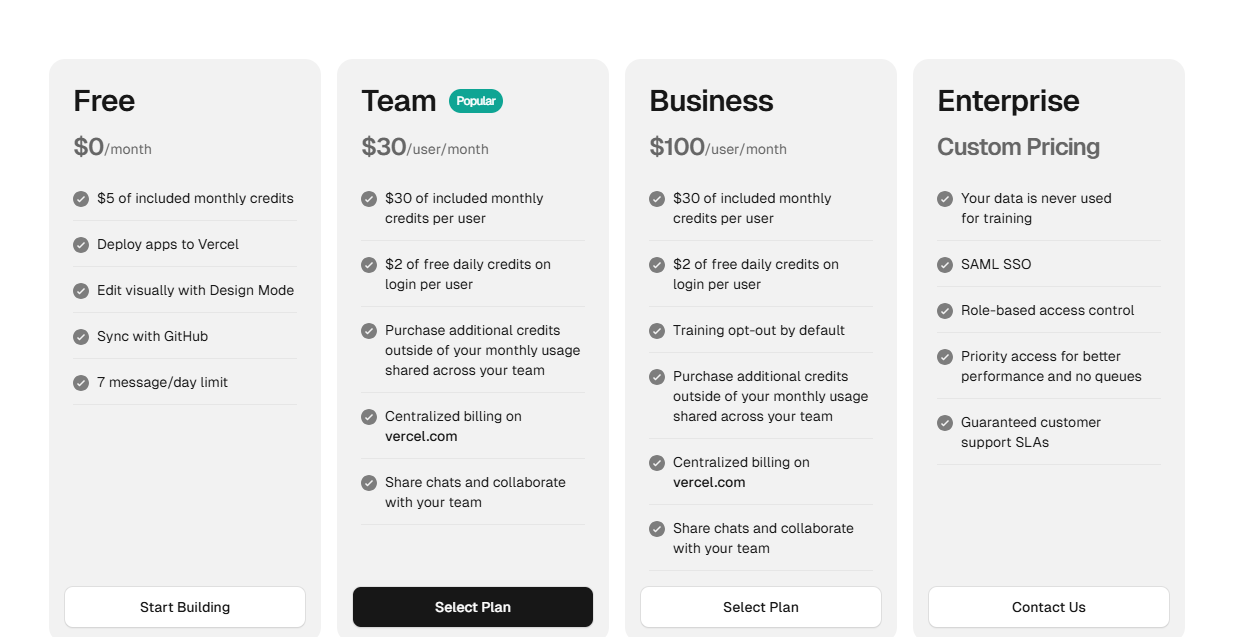
- Free — $0/month — $5/month in included credits, access to v0-1.5-md AI model, GitHub sync, Vercel deployment. Enough for simple prototypes and platform evaluation.
- Premium — $30/month — $20/month in included credits plus Figma import, API access, and priority model access. Additional credits purchasable on demand.
- Team — $30/user/month — Shared credit pool across team members, collaborative workspace, admin controls, centralized billing.
- Enterprise — custom pricing — Advanced security, SSO, compliance documentation, dedicated support, deployment protection requirements.
Token-based pricing means complex full-stack generations can consume credits faster than simple UI components. Always verify current pricing at v0.app/pricing.
v0 vs Lovable vs Bolt
v0 produces the best-looking UI of any AI builder and has the simplest deployment via Vercel. It is strongest for frontend-heavy applications on the React/Next.js stack. Lovable is better for full-stack apps with databases and authentication out of the box — it handles the backend more completely than v0. Bolt offers more framework flexibility than v0 (not locked to Next.js) but generates less consistent code quality. Choose v0 for frontend prototyping and React UI generation; choose Lovable or Bolt when you need a complete application with a backend from day one.