
Postman (postman.com) is the world's leading API platform, used by over 40 million developers from 500,000 organisations to design, build, test, document, and monitor APIs throughout the development lifecycle. Originally known as an API testing and request-building tool, Postman has evolved into a comprehensive, AI-native platform in 2026 — introducing Agent Mode, Git-connected Workspaces, and the API Catalog, a live management plane that provides a single operational view of every API and service across an organisation. According to Postman's own State of the API Report, 89% of developers now use AI in their workflows, and Postman has rebuilt its platform around this reality.
The March 2026 platform evolution embedded Postman's AI intelligence layer directly into the core product — not as a standalone assistant, but running with full context across specifications, test collections, environments, and real production behaviour. Agent Mode allows Postman's AI to understand API collections and underlying code, execute changes, diagnose issues, and apply fixes while operating within existing governance controls. The newly launched AI Engineer (June 2026) represents the next generation of these capabilities, bridging the gap between prototype code and production-ready APIs.
How Postman Works
Developers use Postman's desktop app or web client to create collections — organised groups of API requests with environment variables, pre-request scripts, and test assertions. Collections can be run manually, scheduled via the Postman Monitor, or executed in CI/CD via Newman (Postman's CLI runner) or native integrations. API designs are created using Postman's schema editor and can be synced to Git repositories through the new Git-connected Workspaces. The API Catalog aggregates all APIs, services, collections, test results, and CI/CD activity into one centralised view, giving engineering leaders real-time insight into what APIs exist, who owns them, and whether they are tested and performing correctly.
Key Features
- Agent Mode AI — AI intelligence embedded in the platform with full context across specs, tests, environments, and production behaviour; understands repos, debugs issues, and applies fixes
- AI Engineer — next-generation AI capability for taking APIs from prototype to production, launched June 2026
- API Catalog — central system of record providing real-time visibility of all APIs and services, their owners, test coverage, CI/CD status, and production performance
- Git-connected Workspaces — native Git branch workflow within Postman, keeping collections and API specs version-controlled alongside source code
- API testing and collections — build, organise, and run API requests with environment variables, test assertions, and pre/post-request scripts
- Performance testing — rebuilt load testing engine for detecting performance issues under real traffic before production deployment
- Automated monitoring — scheduled collection runs against production or staging environments with alerting and uptime tracking
- Mock servers — generate mock APIs from collections or schemas to enable development before the backend is ready
- Private API Network — internal API catalogue for sharing and discovering APIs within an organisation
- Free tier — full platform access for individual developers including collections, environment management, and API testing at no cost
Postman Pricing
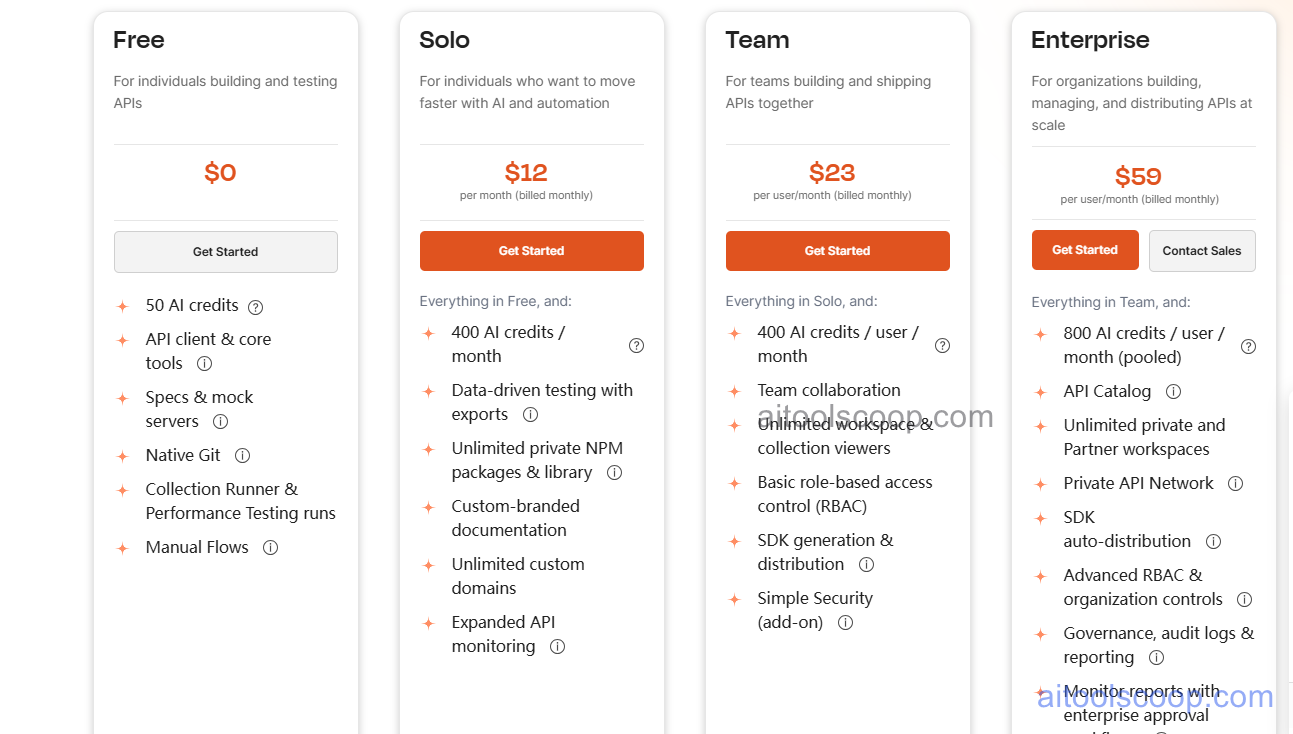
- Free — $0/month — Full platform access for individuals: collections, environment management, API testing, mock servers, and monitoring with usage limits. The most generous free API platform tier available.
- Basic — $12/user/month — Increased usage limits, team workspaces, collection sharing, and collaboration features for small development teams.
- Professional — $23/user/month — Advanced monitoring, custom domains, audit logs, additional mock server calls, Git-connected Workspaces, and priority support.
- Enterprise — $59/user/month — Unlimited usage, SSO/SAML, advanced governance, Private API Network, API Catalog with full portfolio visibility, advanced security controls, and dedicated support.
Always verify current rates at postman.com/pricing.
Who Should Use Postman?
Postman is the default starting point for virtually any developer or team working with APIs. Its free tier is comprehensive enough for individual developers and small teams to cover their entire API workflow — testing, documentation, mocking, and monitoring — without any upfront cost. As teams grow, the paid tiers add collaboration, governance, and the AI-native features that distinguish the 2026 platform. Enterprise teams benefit most from the API Catalog and Agent Mode, which address the real operational challenge of maintaining visibility and quality across hundreds of APIs. Postman is not a runtime API gateway and does not handle production traffic routing, but it integrates with every major gateway and deployment pipeline.
Frequently Asked Questions
What is Postman?
Postman is the world's leading API platform used by 40 million developers to build, test, document, and monitor APIs. In 2026 it introduced AI-native capabilities including Agent Mode (AI embedded in the platform with full context across specs and tests), API Catalog (a central system of record for all APIs and services), and Git-connected Workspaces for native version control of API collections.
Is Postman free?
Yes — Postman offers a comprehensive free plan for individual developers that includes collections, environment management, API testing, mock servers, and monitoring with usage limits. It is the most widely used free API testing tool available. Paid plans from $12/user/month add team collaboration, higher usage limits, and advanced governance features.
What is Postman Agent Mode?
Agent Mode is Postman's AI intelligence layer embedded directly in the platform, launched in 2026. Unlike a standalone AI assistant, Agent Mode operates with full context across API specifications, test collections, environments, and real production behaviour. It can understand Git repositories, execute debugging steps, apply fixes, and suggest improvements — all within existing team governance controls.
What is the Postman API Catalog?
The API Catalog is a central management plane introduced in March 2026 that gives engineering organisations a real-time operational view of every API and service in their portfolio — including which APIs exist, who owns them, whether they are covered by automated tests, their CI/CD integration status, and how they are performing in production. It acts as a system of record for the entire API estate.
How does Postman differ from Stoplight or 42Crunch?
Postman is primarily a testing, collaboration, and monitoring platform — it excels at running API requests, writing test assertions, and managing API workflows across teams. Stoplight focuses on design-first API governance using OpenAPI editors and style guides. 42Crunch specialises in API security auditing and runtime firewall protection. The three tools are complementary and are commonly used together in mature API programmes.