Warp is an AI-native terminal for developers with built-in coding agents, natural language command generation, and multi-agent workflow orchestration. SOC 2 compliant with zero data retention. Free plan available. Build plan from $20/month.
Natural language command suggestions — type # to describe what you wantnAgent mode — multi-step autonomous task execution with configurable autonomynOz cloud agents — run parallel AI coding agents on cloud infrastructuren40-repo codebase context indexing (100K files per repo)nBring Your Own Key — plug in OpenAI, Anthropic, or Google API keysnSOC 2 compliant with Zero Data Retention across all contracted LLM providers
4.5
★★★★★
Agent Performance Score — based on 39 reviews
Autonomy
4.8
Task Completion
4.5
Integration
4.6
Reliability
4.4
Ease of Use
4.7
Pros & Cons
👍 Strengths
AI deeply integrated into terminal UX — not a chatbot bolt-onnBYOK makes Build plan effectively free for teams already paying for LLM APIsnSOC 2 + ZDR makes it enterprise-safe for sensitive codebasesnOz cloud agents enable parallel autonomous coding at scalenFree plan preserves all core terminal features forever
👎 Limitations
Credit system can feel limiting for heavy AI users on the free plannOz cloud agents still in early access — not widely availablenBusiness plan caps at 50 seats, requiring enterprise upgrade for larger teamsnLess focused on code editing than Cursor — best as a complement, not replacement
📖
About Warp
Warp (warp.dev) is a modern terminal that replaces iTerm, Hyper, and default OS terminals with an AI-integrated development environment. Its coding agent understands your terminal session context, shell history, and codebase to suggest commands, explain errors, and execute multi-step tasks autonomously. Warp recently launched Oz, a cloud-based agent orchestration platform that runs parallel autonomous agents for complex engineering workflows — making it a direct competitor to Devin for teams that want agentic coding without leaving their terminal.
Key Features
AI command suggestions — natural language to shell command, context-aware, activates with `#` prefix
Agent mode — autonomous multi-step task execution with configurable autonomy levels (approve-each-step to full-auto)
Oz cloud agents — orchestration platform for running parallel Claude Code instances on cloud infrastructure
Codebase context — index up to 40 repositories (100K files each) for agent-aware command generation
Bring Your Own Key (BYOK) — connect OpenAI, Anthropic, or Google API keys to use Warp's agent harness with your own model billing
SOC 2 + Zero Data Retention — no customer AI data stored or used for training by Warp or contracted LLM providers
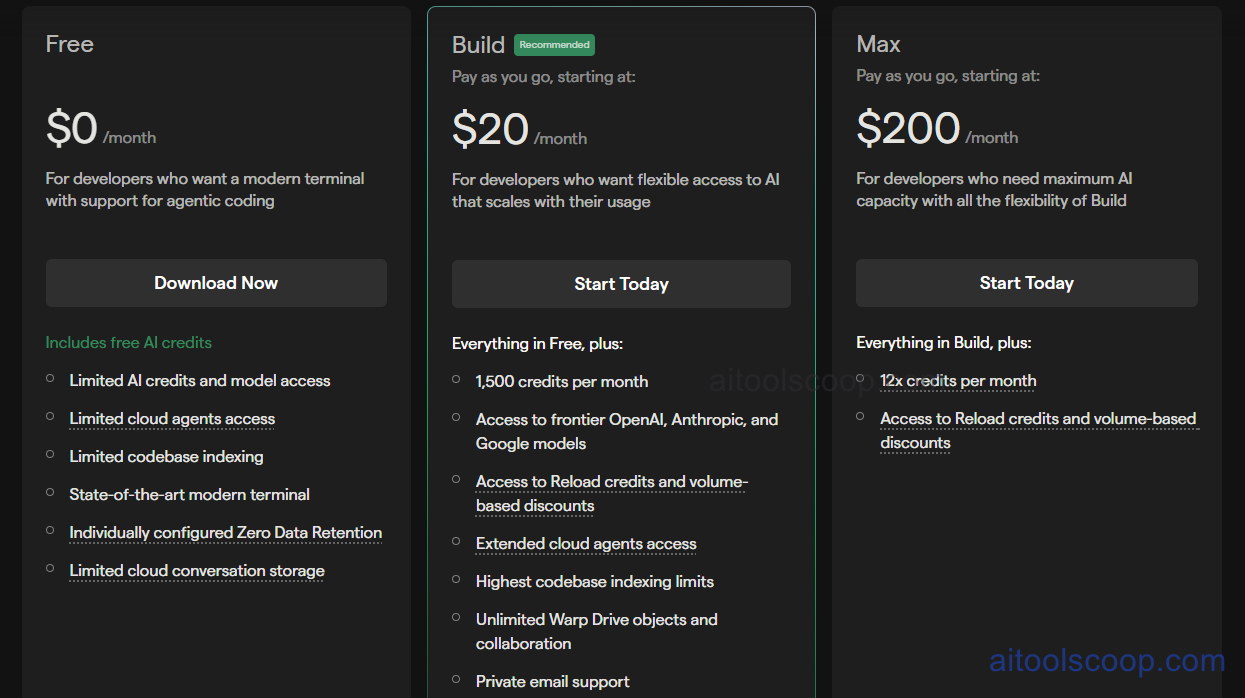
Warp Pricing
Warp: Pricing for AI-native terminal
Free — $0/month — 75 AI credits/month after initial two-month period (150/month). All core terminal features included forever.
Business — $50/month — Everything in Build plus SAML SSO, team-wide Zero Data Retention enforcement, up to 50 seats.
Enterprise — custom pricing — Unlimited seats, dedicated support, custom compliance, and Oz cloud agent access.Pricing is subject to change. Always check the latest rates on the official website. For more AI tool reviews, visit aitoolscoop.com.
Who Should Use Warp?
Warp is the right terminal for individual developers and engineering teams that want AI deeply integrated into their daily command-line workflow — not as a chatbot overlay, but as a native part of the interface. Teams using Cursor for code editing often pair it with Warp for terminal work. The Oz orchestration platform makes it compelling for teams that want to run parallel autonomous coding agents without managing cloud infrastructure directly.
Affiliate Disclosure: This page contains affiliate links. If you click and make a purchase, we may earn a small commission at no extra cost to you. We only recommend tools we genuinely believe in.
🎯 Explore More
Discover other curated resources from our platform
 Freemium