
Best Free AI Writing Tools for Bloggers in 2026
Looking for the best free AI writing tools for bloggers in 2026? After testing tools like ChatGPT, Rytr, Copy.ai, and others, I share what actually helps bloggers write faster—and what doesn’t. This honest guide covers real use cases, unexpected limitations, and how AI writing tools fit into a modern blogging workflow without replacing your voice. If you're a content creator, indie blogger, or building a niche site, here’s what’s worth trying (and what’s probably a waste of time)
Last October, I had one of those small, slightly embarrassing moments that only bloggers understand.
It was 11:47 PM.
I was staring at a half-written article about AI SEO tools. Coffee gone cold. Google Docs open. Cursor blinking like it was mocking me.
You know that feeling when the words just… stop?
Not writer’s block exactly. More like mental friction.
I had the outline. I knew what I wanted to say. But finishing the post felt like pushing a car uphill with one hand.
That’s when I opened three AI writing tools at once.
One tab for ChatGPT.
One for a tool I’d barely heard of called Rytr.
And one random “free AI writer” I found on Reddit.
Honestly, I expected most of them to be useless.
Some were.
But a couple surprised me in a way that actually changed how I run my blog.
Not dramatically. Not magically.
Just enough to make writing faster.
And that matters more than people think.
The uncomfortable truth about blogging now
Let me say something slightly unpopular.
Blogging in 2026 is weird.
Not dead. Not easy either.
The real challenge isn’t ideas. Or even SEO.
It’s consistency.
Publishing every week sounds simple. Until you try doing it for three years straight.
Some days I can write 2000 words in an hour.
Other days 200 words feels like climbing Everest.
AI writing tools — especially free ones — exist in that awkward space between helpful and annoying.
They don’t replace writers.
But they do remove friction.
Think of them like power steering for content creation.
You still drive the car. But the turns feel lighter.
The first tool I kept coming back to: ChatGPT
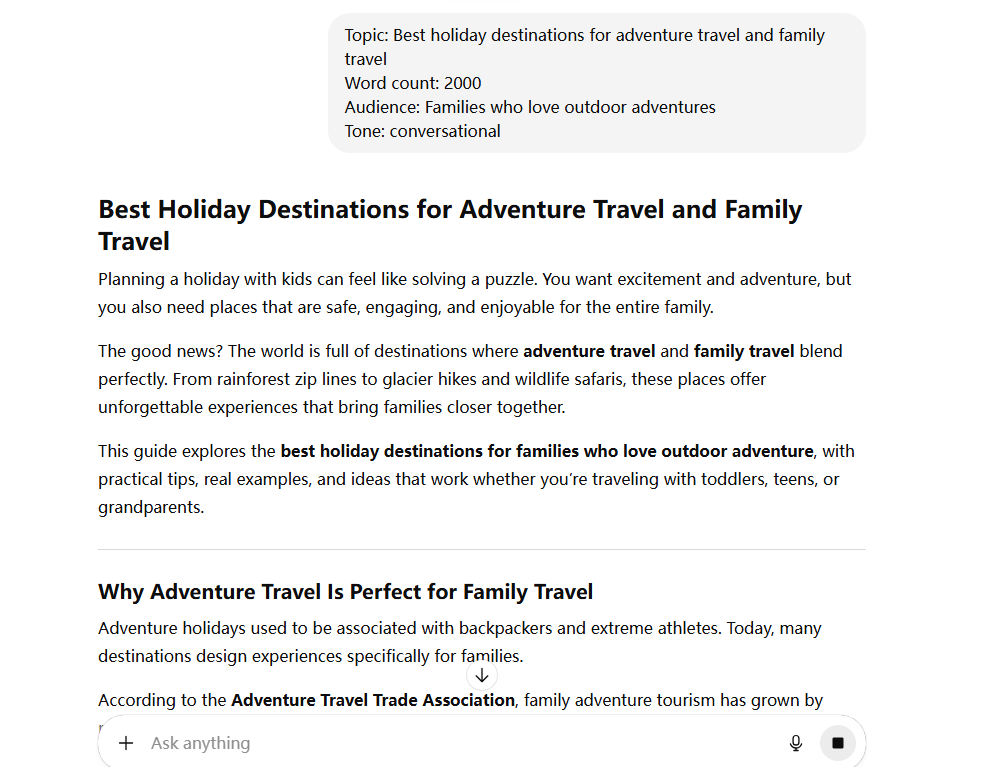
Let’s start with the obvious one.
I tried ignoring it for months.
Mostly out of stubbornness.
Every YouTube video sounded the same:
“AI will write your blog for you!”
No, it won’t.
Or at least not well.
The first time I asked ChatGPT to write a blog post, it produced something that sounded like a polite robot who read too many marketing textbooks.
Technically correct. Emotionally dead.
But once I stopped asking it to write full articles, things changed.
Now I mostly use it for:
- Outlining posts
- Generating subhead ideas
- Rephrasing awkward paragraphs
- Breaking through writer’s block
That last one matters.
Sometimes all I need is a rough draft of a paragraph. Something messy. Then I rewrite it.
People who try to fully automate blog posts usually end up with content that Google quietly ignores.
But as a thinking partner? It’s genuinely useful.
The free version covers most blogging tasks — but the key is learning how to prompt it well. A bad prompt gets you generic output. A specific prompt gets you something actually usable.
The tool that surprised me: Rytr

I’ll be honest.
I expected Rytr to be garbage.
It looked like one of those AI copywriting tools that popped up during the early AI gold rush.
You know the type. Fancy landing page. Big promises.
Still, I tested it for a week.
Here’s what actually happened.
Rytr turned out to be oddly good at small writing tasks.
Not entire articles. But little pieces of them.
Things like:
- Meta descriptions
- Intro hooks
- Product summaries
- Quick outlines
One afternoon I used it to generate five alternative introductions for a post.
Four were bad. One was weirdly good. That one stayed.
The free plan gives you 10K characters per month — enough for regular bloggers to test it properly without spending anything. If you find yourself hitting the limit, the paid plan starts at $7.50/month billed yearly, which is one of the cheapest upgrades in this space.
Would I rely on it for serious long-form blogging? Probably not.
But as a quick idea generator, it earns a permanent browser tab.
Jasper… the tool that made me rethink paid AI writing
Jasper is not free.
It starts at $59 per month per seat — and that’s the entry-level plan.
I tested it during a trial period, and my reaction was complicated.
On one hand, Jasper is powerful.
The templates are built specifically for marketing content. Blog outlines. Email campaigns. Ad copy. You can see the intention.
On the other hand… it often feels like overkill for solo bloggers.
I had a weird moment during my test where I realized I was spending more time adjusting Jasper prompts than actually writing.
That’s when I closed the tab and went back to simpler tools.
For content teams or agencies producing high volume, the price makes sense. For a solo blogger publishing twice a week? Probably not the right starting point.
Sometimes the fancy option isn’t the faster option.
A small tool I didn’t expect to like: Copy.ai

Copy.ai sits in a similar category to Jasper — it’s built for marketing teams and content at scale.
It’s not free. Plans start at $24/month billed annually. So it’s more affordable than Jasper, but it’s still a paid commitment.
I tested it during a trial period when I needed quick product descriptions for an affiliate article.
The outputs weren’t perfect. But they were surprisingly human.
Not amazing. Just… usable. Which is honestly a big compliment in the AI writing space.
Where it works well:
Short-form content. Landing page text. Quick summaries. Email headlines.
Where it struggles:
Long, thoughtful blog posts. The tone drifts. The structure gets repetitive.
For solo bloggers on a budget, it’s hard to justify over ChatGPT’s free tier. But for bloggers running affiliate sites or content businesses who need speed and volume, it’s worth a look.
The tool that failed my expectations
Let’s talk about a disappointment.
Not everything worked.
There’s a category of “completely free AI writers” floating around online. No login required. Just type and generate.
Sounds amazing. Reality was rough.
I tested three of them in one afternoon.
One generated paragraphs that looked like they were translated three times through different languages.
Another repeated the same sentence structure over and over.
The third literally produced half-finished sentences.
Technically free. Practically unusable.
This is where a lot of bloggers waste time. Free tools are great. But there’s a line where “free” just means “unfinished product.”
Where AI writing tools actually help bloggers
After months of experimenting, I’ve settled into a simple workflow.
And it’s probably less glamorous than people expect.
I write the core ideas myself. Always.
Because the best parts of a blog post come from experience. Not prediction.
But AI helps with the boring parts. The mechanical stuff.
Things like:
- Generating title variations
- Expanding outlines
- Rewording awkward sections
- Brainstorming angles
The weird thing is… that’s exactly where most writers lose time.
Not on big ideas. On small friction points.
When those disappear, publishing gets easier.
Who should NOT rely on AI writing tools
This part matters.
Because AI writing tools are not universally helpful.
If you’re building a personal brand blog — where voice and personality are everything — AI can easily flatten your style.
It smooths your rough edges. And those rough edges are often what make readers stick around.
Also, if you hate editing, AI tools will frustrate you.
The outputs almost always need adjustment. Sometimes a lot.
They save time only if you’re comfortable rewriting. If you want “generate → publish,” blogging probably isn’t the right game anyway.
Are free AI writing tools enough in 2026?
Surprisingly… yes.
For most bloggers, the free tiers of tools like ChatGPT and Rytr (10K characters/month) already cover the essential use cases. Copy.ai and Jasper are worth considering only if you’re producing content at volume and need the extra features.
The paid upgrades mainly add scale. More words. Faster generation. Extra templates. Nice to have. Not mandatory.
The bigger challenge isn’t tool access.
It’s knowing what to write about in the first place.
No AI tool solves that. At least not yet.
The real decision bloggers need to make
After using AI writing tools for two years, I’ve landed on a pretty clear rule.
AI should remove friction. Not replace thinking.
The moment you start relying on it to generate entire blog posts, something subtle happens.
Your writing voice fades. Your insights become generic. And ironically… your blog becomes easier to replace.
Free AI writing tools are fantastic assistants.
But terrible authors.
So here’s the decision every blogger eventually faces.
Use AI to move faster.
Or use it to avoid thinking.
Those two paths look similar at first.
But they lead to very different blogs.
And very different results.


